

Infrastructure maintenance vehicles from Castropol - to the rest of the world
posted on 5th Jun 2026 19:01
The tiny Asturian fishing village of Castropol, on the shores of the Eo ría, which here forms the border between Asturias and Galicia (Lugo province), is an unlikely place to find an established train manufacturer, active on the worldwide scene.
Castropol, or rather the Barres industrial estate 3 km inland from the village, is the home of Uromac Systems, founded in 1991. The only railway stations in the vicinity are the halts of Tol and Las Campas de Castropol, 3 km distant further inland, on the metre gauge line from Oviedo to Ferrol, with just two passenger trains daily, and a very infrequent freight service.
Uromac Systems has around 30 employees, and originally manufactured dump trucks and wheelbarrows for the Spanish construction industry. The company then diversified into manufacturing road/rail vehicles, and subsequently focused on developing environmentally-friendly drivelines for its latest vehicles, intended for infrastructure maintenance, especially in metro tunnels, where exhaust fumes and noise from internal combustion engines can be a health hazard for workers.
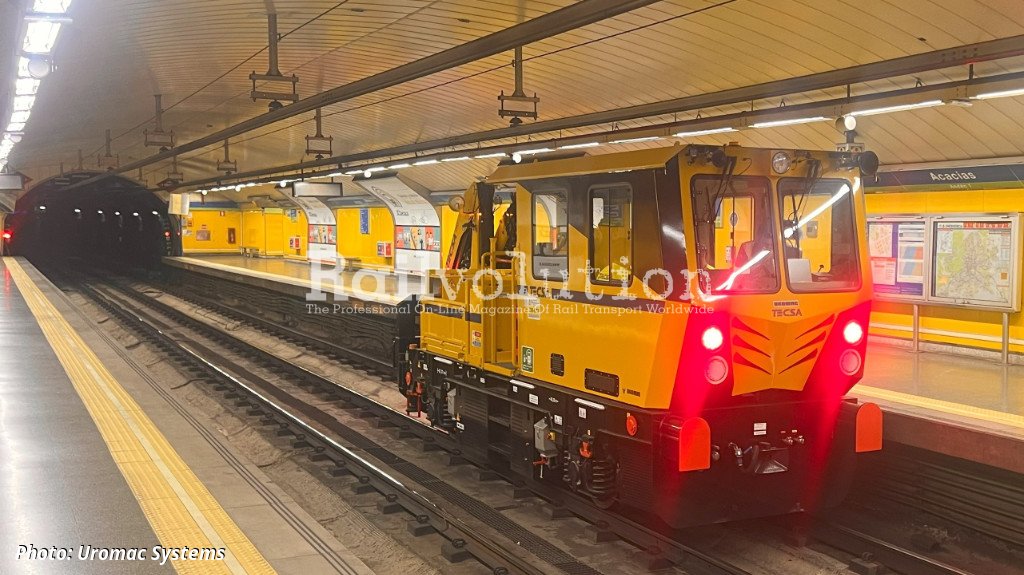
Hybrid draisines for Metro de Madrid
Uromac Systems is currently about to deliver a batch of 24 vehicles (draisines and wagons) to Metro de Madrid, the 40.60 million EUR, 57-month contract being awarded by the Comunidad de Madrid in late September 2025. Of these vehicles, 16 are hybrid draisines, ten are intended for catenary maintenance, and the remaining 14 are for infrastructure (track) maintenance.
In addition, four wagons are being built for the transport of overhead line components, and three for track maintenance components. One more wagon will be supplied for the transport of rails. Simultaneously, another contract, for 4.5 million EUR, for two electric draisines, was awarded by Transports Metropolitans de Barcelona (TMB). Deliveries of the Metro de Madrid draisines will begin in late May 2027.
The Metro de Madrid draisines are two-axle vehicles which can be built for track gauges of 1 435, 1 445 and 1 668 mm. The Metro de Madrid network, 1 445 mm gauge, at 296.6 km and 303 stations, is one of the largest in Europe.
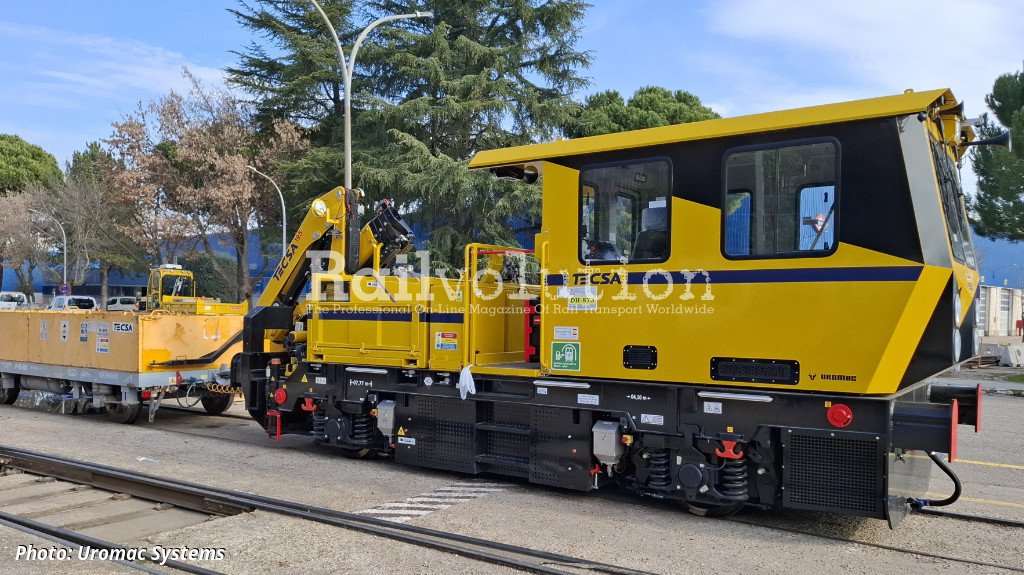
Measuring 7 700 mm in length and 2 300 mm in width, with a height of 2 300 mm above rail top, the draisines weigh 20 tonnes. Maximum operating speed is 50 km/h, and curves with radii of just 30 m can be negotiated. Rail brakes ensure that the draisines are held firmly in position on the track while maintenance work is in progress.
The draisines incorporate Uromac’s Clean Drive 4.0 driveline, and are rated at 212 kW. The driveline combines a small diesel engine functioning in hybrid mode with lithium-ion batteries. On battery power alone up to six hours of operation (movement plus work in required locations) can be achieved.
Charging of the batteries can take place from wayside power sockets, regenerative braking, or from the diesel engine. The objective is to operate on battery power alone in tunnels, thus eliminating air and noise contamination. The batteries, Model INT-53 ENERGY, are supplied by Leclanché, the energy storage company headquartered in Yverdon-les-Bains, Switzerland.
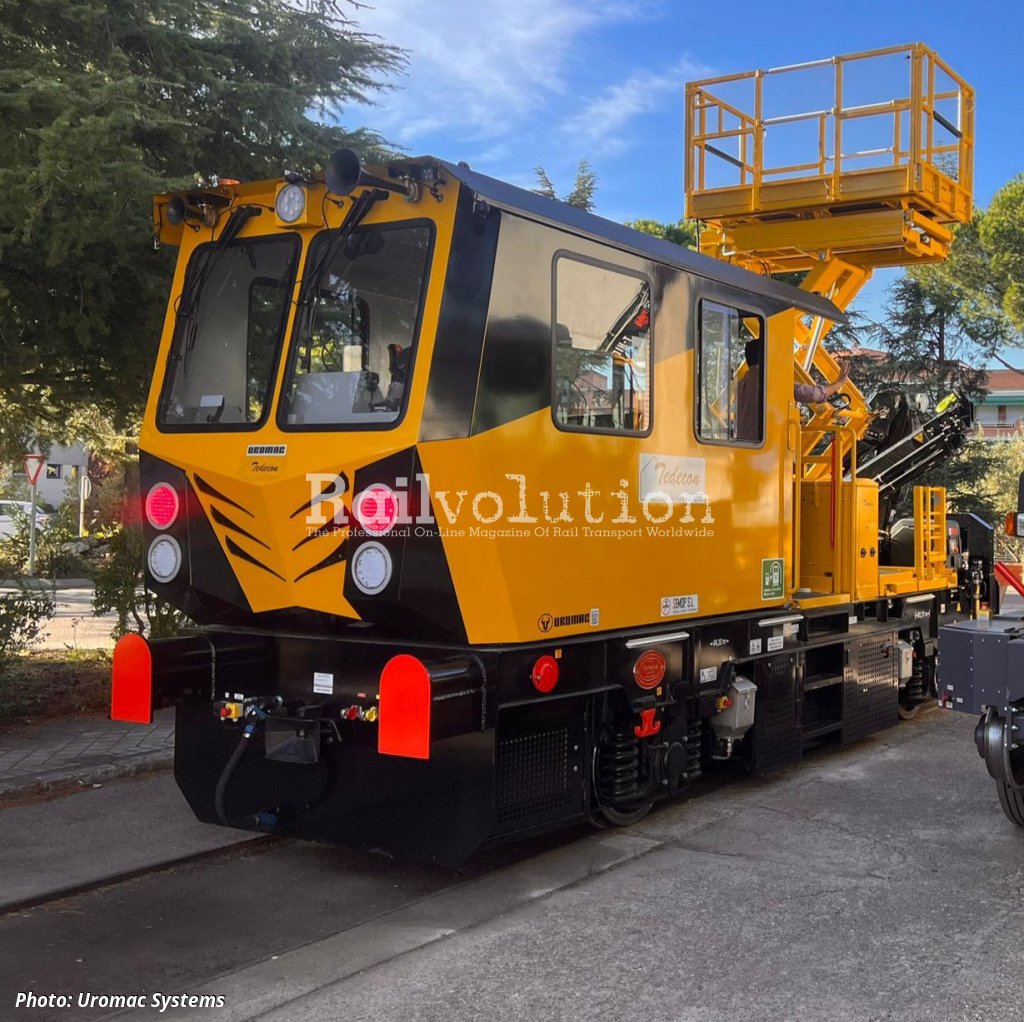
The draisines can be fitted at their front ends with loading cranes, elevating work platforms, towing gear or battery charging equipment. Wagons carrying infrastructure maintenance materials (such as rails) can also be hauled. At the rear of the vehicles there is a pressurised (and hence contamination-free) cabin with seats for up to six workers.
The first two draisines of this type were delivered to Metro de Madrid in early 2024, for use by the companies Tedecon and Tecsa, which undertake maintenance work on the capital’s metro network. The type was also exhibited at InnoTrans 2024, and Uromac will be exhibiting at InnoTrans 2026, in the outside exhibits area (Stand O/230).
