

LZB failure results in fatal rear-end collision at Urda
posted on 29th Oct 2026 17:53
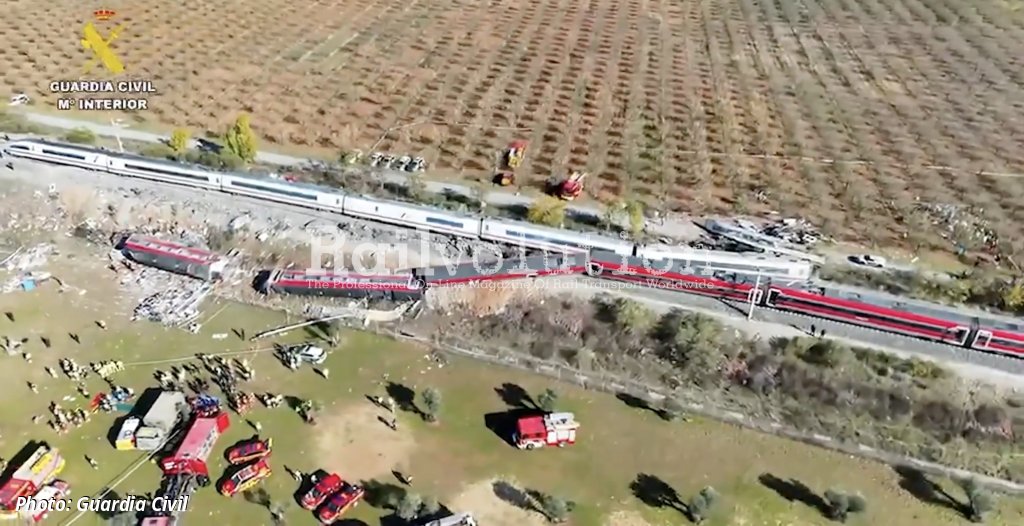
On 28 October 2026, the 07.53 Madrid Atocha - Sevilla Renfe Viajeros AVE service, reporting number 2080, operated by Velaro 103 206, travelling at a higher speed, ploughed into the rear of the stationary 07.40 Madrid Atocha - Sevilla Iryo 109 015 Frecciarossa, reporting number 6076, near the village of Urda, in the south of Toledo province, 120 km from Madrid. The final three cars of the Class 109 unit were knocked down an embankment, while the leading car of the Class 103 unit was derailed, falling down the other side of the embankment. Three of the cars behind it were also derailed, but remained almost upright.
On board the Iryo train were 147 passengers, while the AVE carried 397 passengers. By mid-afternoon the number of fatalities had risen to 64, with several passengers still unaccounted for. 40 of the victims were on board the Class 109 train, 24 on board the Class 103 train. Later in the afternoon the death toll rose to 68, with 58 in hospital, of whom 15 were seriously injured. By the following morning the death toll had not risen, though rescuers worked through the night to retrieve bodies trapped in the wreckage.
The collision took place at 08.53 h. At 09.10 Adif AV (Alta Velocidad) ordered the closure of the line, and all trains on it were halted. An emergency situation in Castilla-La Mancha was declared at 09.15. MITMS minister Óscar Puente arrived at the control centre at Atocha at 09.40 to monitor the situation.
By 11.52 all injured passengers that could be found had been evacuated. Rescue teams then started removing bodies from the trains. The number of dead increased during the afternoon.
At 12.50 Adif AV confirmed that services on the Madrid - Toledo line were running normally, and that it was still possible to operate trains between Málaga, Córdoba and Sevilla. There would be complications over subsequent days - the conventional main line between Madrid and Córdoba is closed through Despeñaperros pass on account of ‘Rail Motorway’ clearance enhancement work. The only alternatives are the two lines to Mérida, thence to Zafra, and the lines to Los Rosales and Huelva.
Óscar Puente appeared before the media at 15.00 confessing that the accident was ‘really inexplicable’. A political storm was brewing, with the opposition parties with daggers drawn and ready to exploit weaknesses wherever they could in the run-up to the general election in November.
Background
It was not long before the chain of events and underlying causes which resulted in the collision were revealed. Given the fact that the Madrid - Sevilla HSL has two levels of ATP - LZB with a backup ASFA Digital - such an accident should never have occurred.
No fewer than 13 technical reports, currently in the hands of the agency Colpisa revealed that since an initial report prepared by Ineco (Ingeniería y Economía del Transporte) in 2019 there had been a series of problems with the ageing LZB ATP on this particular stretch of the high speed line.
On 30 June and 12 July 2025 the ATP failed, and there was another failure on 7 July this year. Theft of cabling was suspected. The 2019 Ineco report recommended the replacement of the electronic interlocking system at Urda (km 119.75, refuge loops), together with the control equipment at nearby Mora (km 89.55, refuge loops) and Los Yébenes (km 104.87). But it was feared that the insertion of modern 2020s train control technology in a system which dated from the early 1990s or late 1980s would result in the capacity of the older system being exceeded.
In February 2020 Adif Alta Velocidad invited tenders for the renovation of the train control system between Madrid and Sevilla. One of the conditions was that the LZB should continue in use after ERTMS Level 2 had been installed and during the installation period. Subsequently, Adif AV reconsidered this, proposing that LZB should be removed once the ERTMS had been commissioned. This caused confusion among the bidders, who had already submitted their proposals, which had been evaluated.
Adif AV concluded that the only way forward was to re-invite tenders, with the changed specifications. The original tender was annulled in November 2020, with bidder Thales protesting. The pertinent tribunal concluded in March 2021 that the offers proposed were now incompatible with the specifications laid down by Adif AV.
Finally, in September 2021 Adif AV awarded Thales España a 93.83 million EUR, 52-month contract to renew the train control system on the line, in such a way that LZB would continue to be active while ERTMS was being installed. This formed one of three contracts to deal with the entire signalling system on the line.
One, for 21.56 million EUR, was for the renewal of track circuits. The other, for 21.02 million EUR, was for pointwork replacement at various locations along the line, including the sets of points accessing the refuge loops at Urda and Mora. Thales would replace 1,306 ageing track circuits with ones which would enable the train protection system to continue functioning while the changeover from LZB to ERTMS took place.
These contracts all formed part of the massive upgrade of the Madrid - Sevilla high speed line, undertaken during the early 2020s at a cost exceeding 700 million EUR.
In May 2024 the CNMC (Comisión Nacional de los Mercados y la Competencia) reckoned that the ATP changeover would take place during 2025 and 2026. In March 2026 government sources stated that the installation of ERTMS was still in progress, but did not reveal where work was taking place or how far it had advanced. What is known is that during 2025 there were 162 different incidents on the line which resulted in trains being delayed. On four occasions a blanket 200 km/h was imposed on the whole line.
The chain of events which led to the tragedy on 28 October 2026 appears to have started during the evening of the previous day. According to Colpisa an AVE service heading from Madrid to Málaga the driver reported that his train had been brought to a halt precisely at km. 120 because it had refused to acknowledge the signals from the APT transponders. The driver asked that his name should not be revealed. That seems to indicate that there was already a defect in the ATP systems.
28 October: the Class 103 AVE...
The chain of events on the morning of 28 October 2026 was as follows:
At 08.30 the LZB failed over a 63 km stretch of the line, resulting in all six trains on that section coming to a halt.
At 08.36 the Atocha control centre informed the drivers of these trains that the fault had been remedied. Permission was given for all six trains to continue their journeys, the fault presumably having been fixed. The traffic controller communicating with the drivers was accompanied by an auxiliary worker ad a supervisor.
The communication with the driver of the Class 103 AVE was as follows, at 08.36:
Atocha: ‘Driver of train 2080. Disconnect [the LZB reception] and reconnect. Start the train, and continue, using BSL [the in-track transponders, not LZB], at normal speed.’
Driver: ‘At normal speed?’
Atocha: ‘Yes.’
The Class 103 did continue, and between 08.36 and 08.53 accelerated to a speed which could have been around 200 km/h. Having covered approximately 25 km, the driver saw the Iryo train ahead (the passing loops at Urda are situated after a long right-hand curve, so visibilty is somewhat restricted) and applied the emergency brake, slowing the speed to around 175 km/h at the moment of impact. There was no further contact between the Atocha control centre and the driver, who was killed in the collision.
... and the Class 109 Iryo
So, why was the Iryo train still stationary? There were two conversations between its driver ad the Atocha control centre. The first was at 08.41, after the driver had received a similar message to that passed to the driver of the Class 103 AVE, and the second followed a failed attempt to reboot and restart the LZB from the cab.
Driver: ‘The train is unable to re-initiate LZB. Because of that I am stopped before the entry signal [to the refuge loops at Urda].’
Atocha control: ‘OK, when you can, and if you have any problems, contact us.’
The traffic controller in Atocha then spoke to his colleagues as follows: ‘Train 6076 is having problems with the ATP equipment… The problem is in Urda.’
Seven minutes later, at 08.48, the driver contacted Atocha control centre with the message, restating the train’s location, while stating a ‘loss of transmission operating with the BSL transponders (Bloqueo de Señalización Lateral, a reference to the signalling blocks created by the positioning of transponders in the track). Atocha centre then asked whether the train was stationary, and the driver confirmed this.
The standard ruling following such an incident is that trains must then continue under a ‘movement on sight’ regime, as if there were no signals operating, at a speed of no more than 40 km/h, and be prepared to stop if another train or a signal at danger is sighted up ahead. It remains unclear why the control centre at Atocha did not inform the driver of AVE 103 206 that Iryo 109 015 was still stranded at Urda, and therefore bring the Renfe train to a halt.
It should be noted that 23 days before the accident, Iryo CEO, Fabrizio Favara, had spoken to a Government commission regarding the fact that the most common problem with the Frecciarossa trains on the Madrid - Sevilla line was the length of time taken to reboot onboard systems (such as automatic braking) following a failure in the wayside LZB: “As regards the Madrid-Sevilla line, the most frequent issue, apart from the effects of outside events, such as fires, is related to the LZB. This is a safe but rather old system. Every time the train loses contact with the wayside infrastructure, it stops. It is immobile, and it takes quite a long time to reboot the onboard system and get moving again.”
Questions...
The person in the control centre who had given the ‘right away’ to the stoped trains was subsequently interrogated by the Guardia Civil (the quasi-judicial police force). By mid-evening on the 28th the data recorders of both trains were being investigated, and the recordings (the soundtracks are not all that clear, the conversations sounding muddled and confused) were being released to the media. What was evident that drivers were not ordered to continue under ‘marcha a la vista’ (the 40 km/h limit).
The language used was casual, and not a standard form of giving commands as used in the aviation and shipping world, or on many railway systems in other countries. This was in spite of actions taken by Adif in the recent past to tighten up on the training of traffic controllers to avoid human errors in communications and actions.
In its 2025 annual report the AESF (Agencia Estatal de Seguridad Ferroviaria) had noted ‘an increase in the number of collisions and derailments on account of weaknesses in the human factor of operations, in particular, since 2021. In 2023 four instances were noted, and in 2024, six. This was attributed to:
- overloading people with too much work or responsibilities,
- lack of updating people on knowledge,
- a shortage of specialists,
- lack of investment in automation of processes.
Particular emphasis was placed on the necessary authorisation given to drivers to pass signals, which requires a precise knowledge of conditions on the track to ensure that this is done safely. In many cases simple visual inspection is insufficient.
