

Next stage of construction begins at HS2’s longest green tunnel
posted on 9th Dec 2025 22:02
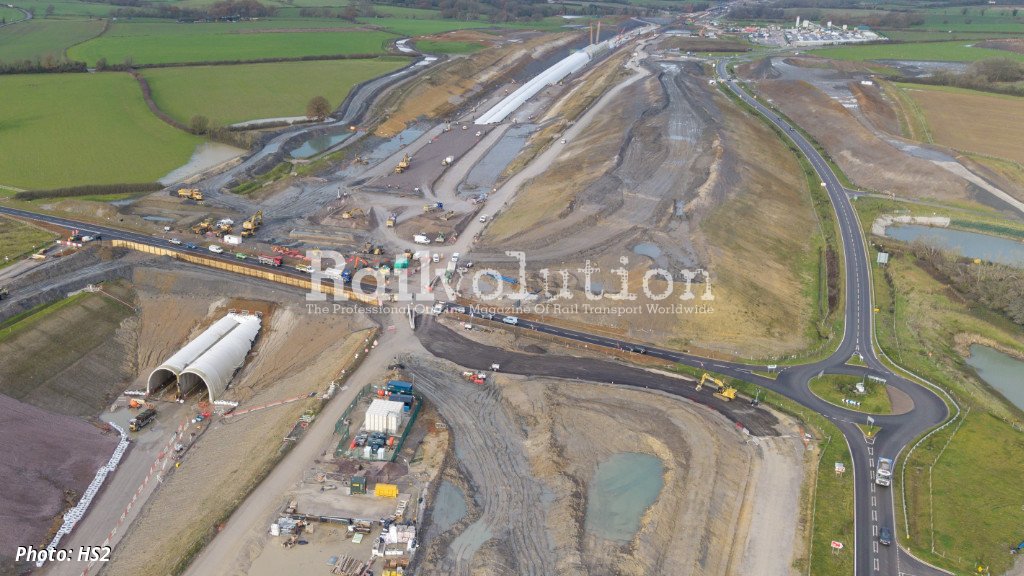
The construction of HS2’s longest green tunnel took a major step forward in early Decemver 2025 with the realignment of a key local road, freeing up space for the next phase of excavations. Set to stretch for 2.7 km, the tunnel is being built inside a shallow cutting near Greatworth, West Northamptonshire, using a ‘cut-and-cover’ technique, with the earth put back on top afterwards. This helps to blend the railway into the landscape.
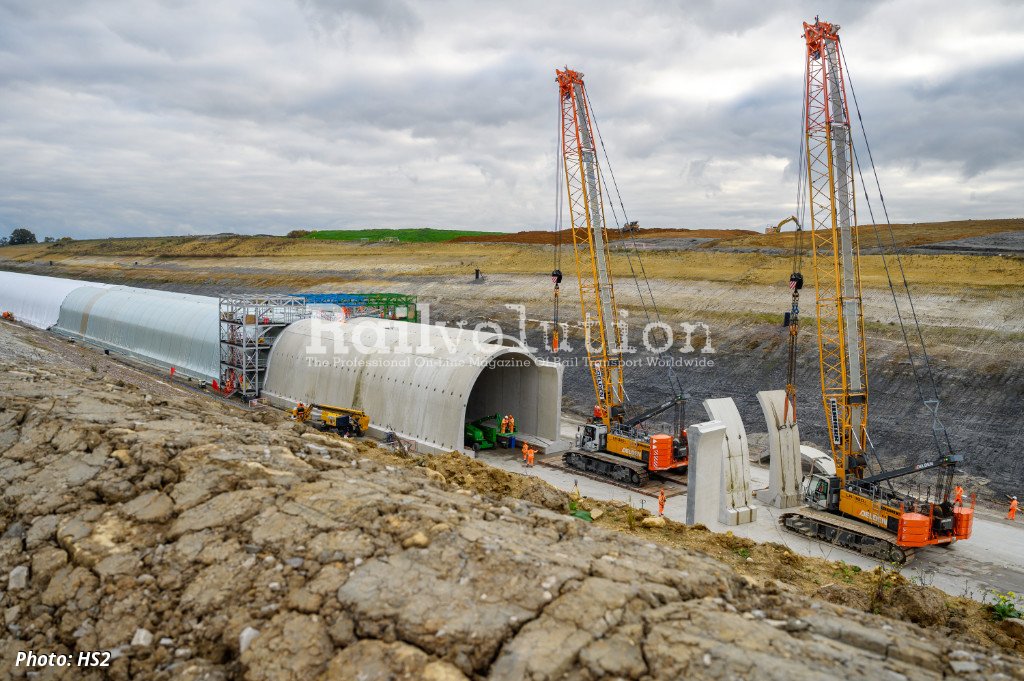
Engineers working for the high-speed rail project have already assembled the first kilometre of the structure and the temporary realignment of the B4525 will allow work to begin on the next stage of the tunnel. Assembled from precast concrete segments, the tunnel is in an ‘M’ shape, with separate halves for northbound and southbound trains. Inspired by similar structures on the French high-speed network, the approach promised to be quick to assemble, with much of the work done offsite. The nearby Chipping Warden green tunnel uses a similar design and the teams at the two tunnels have been able to learn lessons from each other.
Work began first at Chipping Warden where it quickly became clear that the initial construction schedule was overly optimistic with the team facing significant productivity challenges. Recognising the need to improve productivity, HS2 Ltd worked closely with their main works contractor EKFB - a group made up of Eiffage, Kier, Ferrovial Construction and Bam Nuttall - to identify and put in place a series of improvements to the construction process. As a result, the teams at both tunnels are now installing around five to six segments per day - more than double the rate at Chipping Warden during the start of work in 2022/23.
Once complete, the tunnel will help protect the rural landscape and reduce disruption for people living nearby. The construction of the tunnel is happening in stages, with the cutting first being excavated and then a layer of ‘blinding’ laid to form a concrete base for the structure. To speed up the blinding process, the steel reinforcing bars are now being delivered as a ‘roll mat’ with the parallel bars connected by mild steel tape so they can be quickly rolled out ready for the concrete pour.
The next stage involves the assembly of the five concrete segments that form each of the ‘M’ shaped sections of tunnel. Continual improvements have been made to the delivery and installation process to improve the speed and accuracy of the assembly and cut unnecessary waiting time. Once the structure has been assembled, a concrete ‘invert’ slab is poured to form the base for the track. This process has been sped up by changing the direction from which concrete is delivered and by introducing prefabricated reinforcing cages which has doubled the speed of the work. The valley in the top of the ‘M’ is now being filled with an aerated concrete mix, which is faster and more reliable to install than aggregate.
All of the improvements were tested at Chipping Warden at a specially built section of test tunnel, allowing the team to experiment with new approaches offline without risking further delays to construction. This testing, and a rigorous focus on improving the logistics of the complex process, which is now directly delivered by EKFB, contributed to a doubling of the install rate for tunnel segments at both Chipping Warden and Greatworth. Taken together, these improvements help to reduce interfaces between separate teams working at the very restricted space at the face of the tunnel and build flexibility into the programme to help manage any unexpected delays.
Once complete, HS2 will improve journeys between the UK’s two largest cities while freeing up space on the existing West Coast Main Line for more freight and local services. While significant progress is being made on many parts of the project, some of the civil engineering is further behind. As a result, Mark Wild, HS2 Ltd’s chief executive, is now leading a comprehensive reset of the programme to deliver the railway in the most efficient way possible and for the lowest reasonable cost.
Trains will travel underground for 32 miles with major tunnels under the Chilterns and the approach to London and Birmingham, dug using tunnel boring machines, as well as five cut-and-cover tunnels like the one at Greatworth. These are called ‘green tunnels’ because the structures are landscaped on top and designed to blend into the countryside. Lessons from Chipping Warden and Greatworth are also being applied at Wendover in Buckinghamshire. The other two green tunnels – Copthall on the outskirts of London and Burton Green in Warwickshire – are relatively short and use a different, cast in-situ, approach to construction.
