

RemODtrAIn for secure remote control of trains in depots
posted on 5th Dec 2025 10:51
The RemODtrAIn (Remote operated train with AI based Obstacle Detection) consortium, led by Siemens Mobility, is developing and testing a secure remote control system and a modular, AI-supported obstacle detection system for digital train operations in depots. The project builds on key insights from previous projects such as AutomatedTrain and safe.trAIn, strengthening the positive collaboration with Deutsche Bahn.
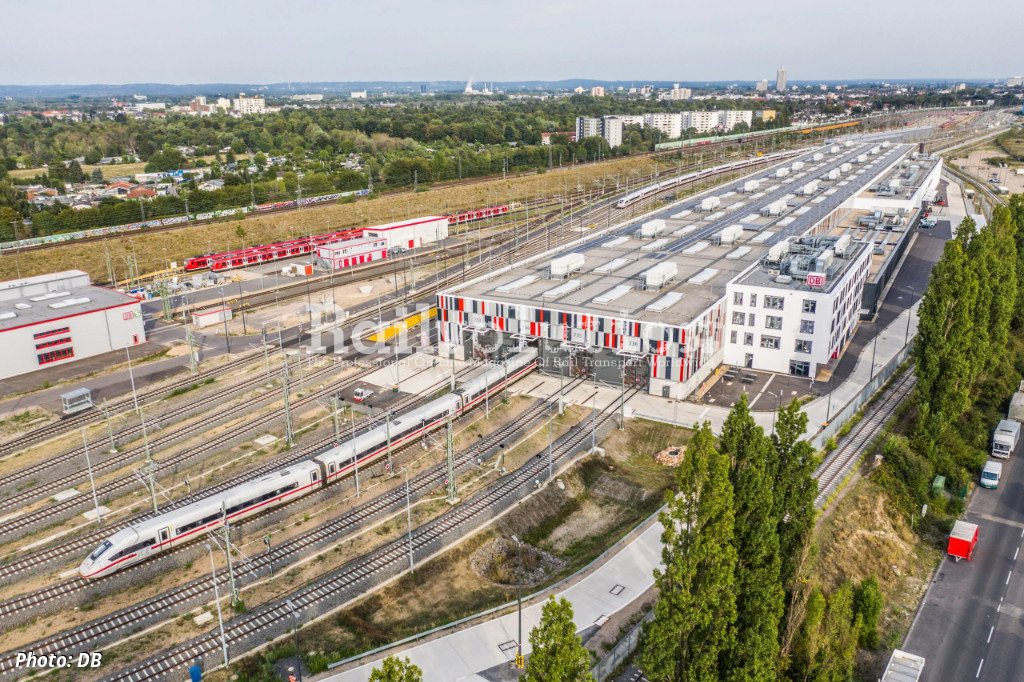
As part of the project, an ICE 4 will be equipped with state-of-the-art 5G technology. This will allow the train to be remotely controlled from a central operating station on the depot premises. The consortium, comprising of industry, operators, and academia, aims to enable secure and highly available remote-controlled train operations by combining various technological innovations, even under different communication conditions in a public 5G mobile network. The project is supported with 17 million EUR within the framework of the funding program "DNS der zukunftsfähigen Mobilität. Digital – Nachhaltig – Systemfähig" (DNS of Sustainable Mobility. Digital – Sustainable – System-capable) by the Federal Ministry for Economic Affairs and Energy.
Marc Ludwig, CEO Rail Infrastructure at Siemens Mobility: "With RemODtrAIn, we at Siemens Mobility are advancing automated rail operations. Together with strong partners from industry, research, and the railway industry, we are developing solutions that are not only technologically advanced but also precisely tailored to the current requirements of rail operations. Siemens Mobility is responsible for specification and development of a remote control system, as well as its integration and practical testing. Our goal is to make remote-controlled operations in the depot and premises safe, efficient, and scalable. This is a decisive step towards digitized rail operations."
Dr. Jasmin Bigdon, Chief Technical Officer, Deutsche Bahn AG: "With the RemODtrAIn project, Deutsche Bahn is taking an important step towards the remote control and automation of shunting movements. Our goal is to develop a pragmatic solution for remote-controlled train operations by closing specific technological gaps and to consider necessary adjustments in roles, processes, and regulations. The close integration of technical solutions and real-world application on-site is the focus of our actions: DB Fernverkehr AG, as the demand owner, contributes the operational requirements. Part of the testing will take place on the premises of DB RegioNetz Infrastruktur GmbH in the Erzgebirge.
DB Systemtechnik GmbH contributes system engineering, architecture, safety and cybersecurity expertise, as well as experience in standardization and approval. With remote control in shunting operations, we aim to increase capacities, make processes more flexible, alleviate staff shortages, and thus achieve tangible operational improvements quickly for customers and our employees."
The focus of "RemODtrAIn" is on train availability, depot, and stabling movements. The vehicle sensors are designed for universal applications in all operating modes. The consortium project thus also addresses the challenge of a shortage of train drivers and aims to further develop automated and remote-controlled train operations, thereby advancing the digitalization of the rail system.
The development of requirements for remote-controlled operations, the specification of a safety-critical architecture as a modular kit for step-by-step implementation, and the realization and testing in a real operational environment are the essential building blocks of the RemODtrAIn project. Remote provisioning will be exemplified on a long-distance train, but retrofit solutions for existing and regional trains are also being considered.
The communication solution will be tested in the 5G test field Smart Rail Connectivity Campus in Annaberg-Buchholz on the Erzgebirgsbahn with a Desiro Classic. Obstacle detection is planned to be tested on the S-Bahn Berlin in daily operation. The vehicle testing and validation phase is scheduled for 2028. The solution is being developed in a future-proof manner in coordination with leading mobile network companies, also considering the increasing potential of satellite communication.
A total of 12 companies from various sectors are collaborating on the project: Siemens Mobility GmbH, Siemens AG, DB AG, DB Fernverkehr AG, DB Systemtechnik GmbH, DB RegioNetz Infrastruktur GmbH, Mira GmbH, Smart Rail Connectivity Campus e. V., Deutsches Zentrum für Luft- und Raumfahrt e.V. (German Aerospace Center), Technische Universität Berlin, Technische Universität Chemnitz, Technische Universität München.
