

Two Rodalies derailments in one evening
posted on 22nd Jan 2026 06:37
Following several days of torrential rain cause by the named storm Harry, which prompted AEMET, the Spanish meteorological service, to issue a red warning, two derailments occurred on the Catalan Rodalies network, one with a fatality.
The most serious occurred on the railway between Sant Vicenç de Calders and Martorell, used by Rodalies R4 trains (Sant Vicenç to Barcelona and Manresa). Here a retaining wall collapsed onto the track at about 21.00 during the evening of 20 January, roughly halfway between Sant Sadurní d’Anoia and Gelida, where the permitted line speed is 130 km/h.
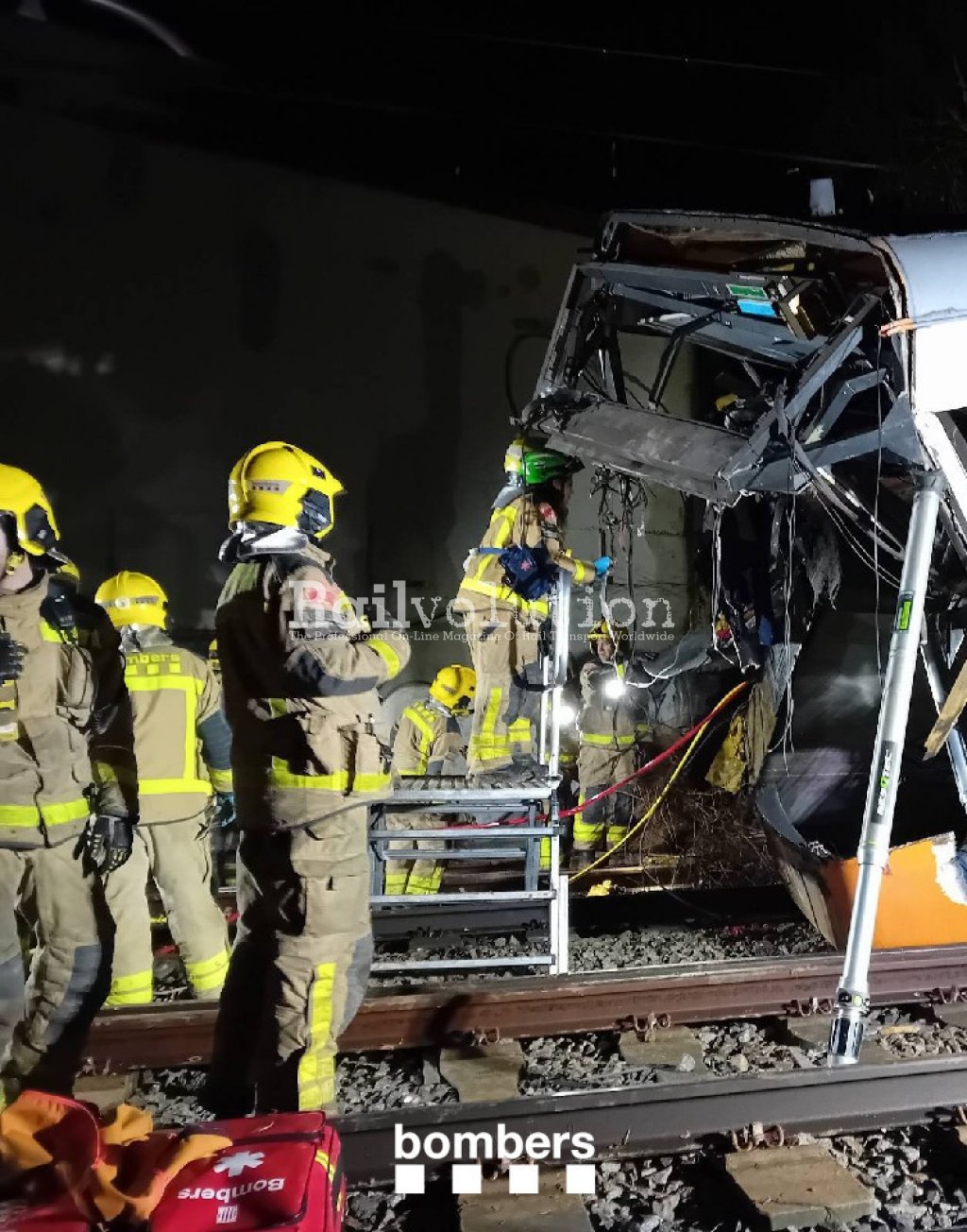
Very soon afterwards a Barcelona-bound Rodalies EMU ploughed into the rubble which had spewed across the track. The emergency services were alerted at 21.02. At least 37 of those on board were injured, five or six seriously, all requiring hospital treatment or supervision. A temporary field hospital was set up on a football pitch at Sant Sadurní d’Anoia, some 12 km from the site of the derailment.
By early on the 21st the number of passengers injured was still only provisional, the statistics provided to the media varying. The one fatality was in the driving cab of the train, either the driver or one of the two or three trainee drivers who were on board. Renfe has so far not released details.
The other incident was on L1, from Barcelona to Mataró and Maçanet-Massanes, between the latter station and Tordera. On board this EMU there were only ten passengers. The train derailed, and lost a wheelset after running though stones which had fallen onto the track, the result of a landslide.
Following a request by SEMAF, the drivers’ union (Sindicato Español de Maquinistas Ferroviarios), and CECAT (Centre de Coordinació Operativa de Catalunya) Renfe announced the suspension, at least during the morning of the 21st, of all Rodalies and Media Distancia services on the Catalan network. The network remained at a standstill ‘for safety reasons’, while inspections of infrastructure were carried out.
160 km/h between Madrid and Barcelona
During the morning of 20 January 2026, Adif announced that it had placed around 25 % of the 667 km high speed line between the Spanish and Catalan capitals under a temporary 160 km/h speed limit. This extends 150 km from Mejorada del Campo (Madrid province) to Alhama de Aragón, in Zaragoza province.
The limit was enforced following requests by SEMAF, in response to warnings by several drivers, who had observed excessive vibration at speeds approaching 300 km/h. Journey time between Madrid and Barcelona will be increased by around 30 minutes.
Similar vibrations have been noted both by drivers and passengers on other high speed lines, such as Madrid to Córdoba and Málaga and Madrid to València. In August 2025 SEMAF approached Adif over this issue, but no action was taken.
