

ELBAHU IV
posted on 9th Apr 2026 20:20
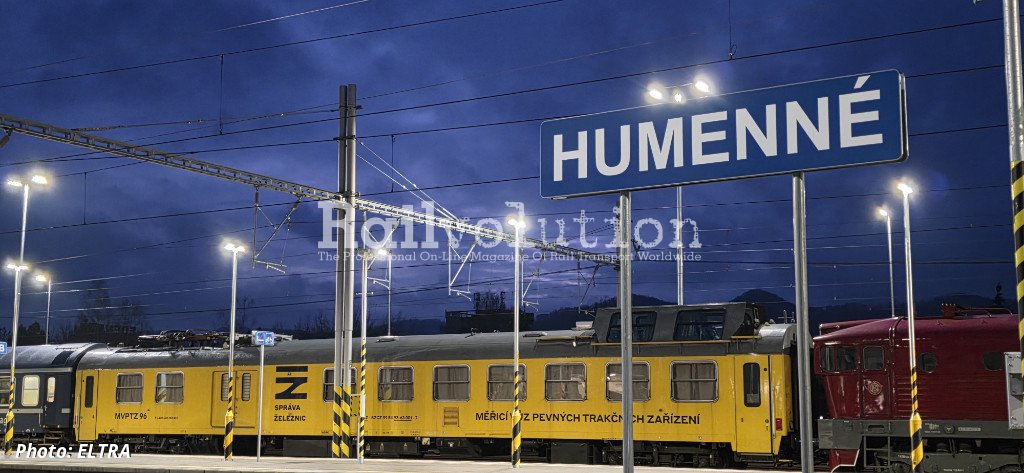
The electrification of the Bánovce nad Ondavou - Humenné line brought the usual effects resulting from such projects: ecological transport became even more ecological, residents living along the line are less bothered by noise and exhaust fumes, the quality of railway infrastructure and stations has increased significantly (including unused stops...), passenger transport has slightly accelerated and its scope has been slightly increased. And it would be nice if in the future this modernisation worth 221 million EUR also generated benefits in the form of the desired transfer of goods and people from road to rail.
First round of questions
In view of the described results of ELBAHU, we contacted Pascal Boijmans, Head of Unit CZ, SK at DG REGIO, and Magdalena Kopczyńska, Director General of DG MOVE. As you probably know, no ATP was installed during the electrification of the Bánovce n. O. - Humenné line and the associated total reconstruction (there was no ATP in the original state). The construction is by 5 % financed from the Slovak budget and by 95 % from EU funds.
The core of the problem we are talking about here is that in the Czech Republic and Slovakia, with reference to EU requirements, the principle is applied that when modernizing railway lines on which there was no train protection system before, no ATP other than the ETCS may be installed. In practice, this leads to the fact that the line is modernized, but if it does not make sense to install an ETCS, the (older) national Class B ATP is not installed either. From the EU's perspective, does this rule really apply to all member states?
Our other questions are:
1) If, as a competent EU body, you see that the line is being fundamentally modernized with EU money, but there will be no ETCS on it, do you not demand the installation of an ETCS under the threat of stopping the co-financing of the project? Or would you still prefer to support a reconstruction of the line that means preserving the outdated state for another 50 years?
2) If, as a competent EU body, you see that the line is being fundamentally modernized with EU money, but there will be no ETCS on it, are you willing to propose an increase in the budget of such a project to also cover the installation of ETCS? If so, was this also the case in the case of the Bánovce n. O. - Humenné line?
3) Have you been informed about the reasons why ETCS was not installed on the Bánovce n. O. - Humenné line?
4) Are you never able (willing) to make an exception for co-financing the reconstruction of the line with the installation of a different ATP than ETCS?
5) If Slovakia paid for the entire reconstruction of the Bánovce n. O. - Humenné section itself, could ŽSR install a Class B ATP?
6) Are you also informed that passenger trains do not stop at five stops on the Bánovce n. O. - Humenné line, which were completely newly built (Laškovce, Michalovce zastávka, Petrovce nad Laborcom, Nacina Ves a Pusté Čemerné)? And that this will probably be the case for several more years?
Then we received answer from a Commission’s spokesperson:
1. "The modernization of the Bánovce nad Ondavou - Humenné railway line is part of Investment 1: Development of low-carbon transport infrastructure in Slovak Recovery and Resilience Plan, in particular under target 3.8 related to Reconstruction or upgrade of at least 49,7 weighted km of public transport infrastructure, and target 3.9 related to the deployment of 82 weighted km of digitally secured railway lines.
2. In the framework of the Recovery and Resilience Facility, measures have to comply with conditions outlined in respective Annex to the Council Implementing Decisions. In case of Slovakia, you may find such CID Annex here. The deployment of ETCS on above-mentioned line is not a requirement under neither target 3.8, nor target 3.9. Therefore, the Commission will not assess whether the line is equipped with ERTMS.
3. The Commission cannot unilaterally increase the budget or modify the scope of a project to add ETCS. Any such change would have to be proposed by the Slovak authorities and assessed under the applicable rules.
4. The Commission is informed of the overall scope and objectives of projects submitted under the RRF. The detailed technical rationale for selecting or not selecting specific signalling systems lies with the national authorities and the infrastructure manager. Please note also that targets 3.8 and 3.9 has not yet been assessed, as it is due only in Q2 2026.
5. The line in question is not located on TEN-T core, extended core, or comprehensive networks and ETCS deployment is therefore not mandatory under EU law for this section. The final assessment if a line is fit for operations must be done by the national safety authorities, responsible for issuing an authorisation for putting the line into service after construction or renovation. This includes the assessment of the train detection and other systems ensuring safe train operations on the lines.
6. Decisions on timetables, stopping patterns and passenger services fall under the responsibility of national authorities and railway operators. EU funding can support infrastructure investment, but it does not determine how services are operated once the infrastructure is in place."
Second round of questions
Since we were not satisfied with the answers, we wrote the following to a Commission’s spokesperson:
Dear, thanks for your answer. But, sorry, you haven't answered practically anything I asked, just phrases... How is someone supposed to orientate in EU legislation if there is anything precise and understandable from you? So we are sending you our questions again and ask you to answer our questions specifically, clearly and directly. Thank you. See below:
The core of the problem we are talking about here is that in the Czech Republic and Slovakia, with reference to EU requirements, the principle is applied that when modernizing railway lines on which there was no train protection system before, no ATP other than the ETCS may be installed.
Why did you delete our question "From the EU's perspective, does this rule really apply to all member states?" This is very important for us, and for the policy which is applied in the Czech Republic and Slovakia.
Ad 1) again: If, as a competent EU body, you see that the line is being fundamentally modernized with EU money, but there will be no ETCS on it, do you not demand the installation of an ETCS under the threat of stopping the co-financing of the project? Or would you still prefer to support a reconstruction of the line that means preserving the outdated state for another 50 years?
The second answer: "It is the responsibility of the Member States to comply with EU law. While the core and comprehensive networks must be equipped with the European Rail Traffic Management System (ERTMS) according to fixed timelines, outside those networks all newly build or upgraded tracks should be equipped with ERTMS as well."
We reacted: But as you can see, the line Bánovce n. O. - Humenné was not equipped with the ETCS (and is also without the Type B ATP). And as you can also see, some member states do not comply with EU law... So the EU doesn't mind supporting projects with huge amounts of money that means preserving an outdated state without increasing operational safety for future 50 years? Although the railway is supposed to be the means of transport of the future?
Ad 3) again: If “The Commission cannot unilaterally increase the budget or modify the scope of a project to add ETCS and any such change would have to be proposed by the Slovak authorities and assessed under the applicable rules“, have you not received a request from the Slovak side to install Class A or B ATPs on the Bánovce n. O. - Humenné line?
The second answer: "It is not possible to provide information related to confidential discussions with the Member State authorities. Legally binding requirements are included in the Council Implementing Decision Annex. Regarding target 3.9, the Council Implementing Decision does not define the exact types of dispatching/digital security technologies needing to be installed. The Commission will assess the compliance of this project with these requirements."
We reacted: Sorry, but what is confidential on the negotiations concerning the public money of all EU members? And all of us... The problem is that there is NO automatic train protection on the Bánovce n. O. - Humenné line! Neither of type A or B! So again, the EU is supporting project that means preserving an outdated state without increasing operational safety for future 50 years… Does anyone really find this strange? Do you even realize what you are (sometimes) supporting?
Ad 6) again: If "EU funding can support infrastructure investment, but it does not determine how services are operated once the infrastructure is in place“, does it mean that the EU spends billions of EUR annually on subsidies for rail infrastructure projects and does not check whether the funds spent are actually used? And analogically, does anyone in the EU mind that you heavily subsidize the modernization of lines, but they in fact do not improve operational safety?
Our new question was: Have you had a case in the last 10 years on a line, for example in Poland, Hungary or Germany or in another European country, where Class B ATP was installed during the modernisation of a line on which there was no interlocking before?
The answer was: "Yes, outside the core and comprehensive networks the Interoperability directive allows in well justified cases to refrain from equipping tracks with ERTMS if the Member State responsible allows it and the modernisation (new construction or upgrade) project would otherwise not be economically viable. However, such justification is particularly challenging for new-build projects."
We reacted: Please tell us the lines in Poland, Hungary and Germany, where Class B ATP was installed during the modernisation of a line on which there was no interlocking before.
Third round of questions...
Subsequently we received this answer: "Thank you for your continued interest in this topic. We have well received your additional questions. To have access to our most comprehensive and up-to-date resources, we would encourage you to consult our dedicated ERTMS webpage, which includes a technical Q&A section that may address many of your queries. Additionally, our Third ERTMS Work Plan, published in February, offers a thorough overview of the current progress, challenges, and next steps in the rollout.
We also have dedicated country fiches which provide a brief overview of the ERTMS deployment per country: Deployment: Status per country - Mobility and Transport.
You can also find more information on EU funding for ERTMS: EU funding for ERTMS - Mobility and Transport - European Commission.
Please also note that the Recovery and Resilience Facility is a performance based instrument, meaning that we first need to receive a payment request to assess whether requirements have been put in place or not. You can find additional information in Slovakia’s recovery and resilience plan - Reforms and Investments and in Czechia’s recovery and resilience plan - Reforms and Investments."
We responded to this with a letter, which can be found in the ELBAHU V.
