
Óscar Puente stepped down from his position as MITMS minister
posted on 8th Nov 2026 09:04
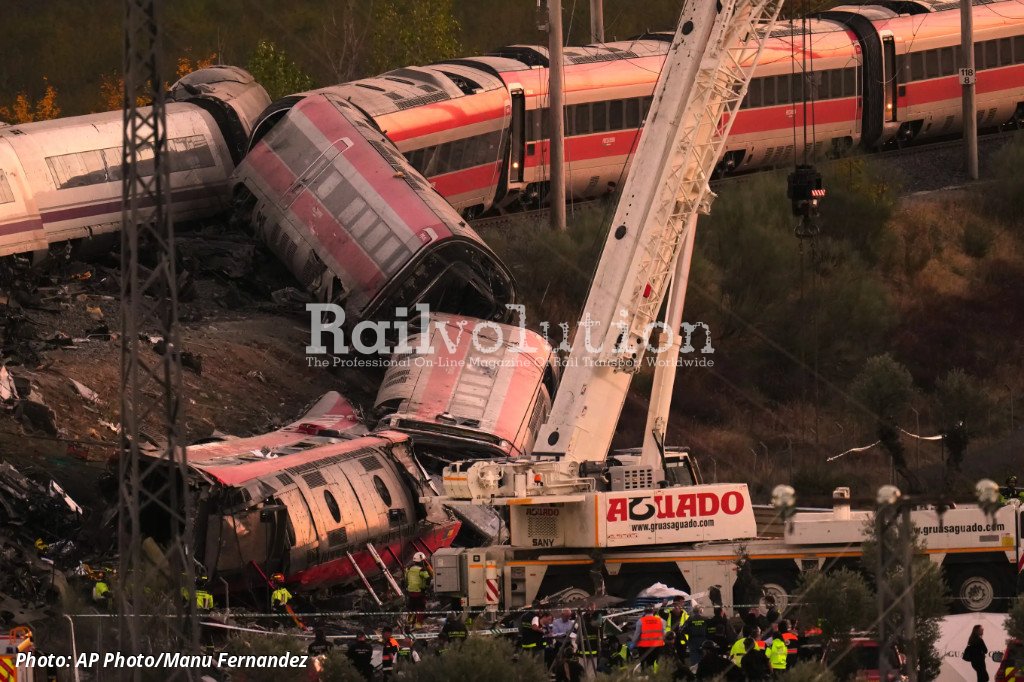
On 3 November 2026, Óscar Puente stepped down from his position as MITMS minister. He explained: "A Minister of Transport in a country like Spain is not possible to retain his position following two serious accidents like Adamuz and Urda. My resignation is a question of political dignity, coherence and empathy with the victims, whether or not I am directly responsible."
During the afternoon of 3 November in the Lower Chamber (Congreso de los Diputados) MITMS Minister Óscar Puente announced his proposals for addressing the problems faced by the Spanish high speed rail network. The Council of Ministers had already given the green light to his plan.
The Agencia Estatal de Seguridad Ferroviaria (AESF) is to undertake a thorough review of all the train protection systems on the Madrid to Sevilla high speed line. Until early 2027 the number of services operated is to be reduced. At present it is envisaged to reopen the line by mid-November.
Puente admitted that the date when ETCS Level 2 can become operational on the line, originally envisaged for April 2027, has been delayed. The installation of the wayside infrastructure over the 471 km of the line had been completed in June this year. But testing is still necessary. The results of the tests then have to be submitted for laboratory analyses and then approval by the AESF. Tests have already been made over the stretch between Madrid and Córdoba, with Córdoba to Sevilla yet to be subjected to tests. These tests take place at night, and only at weekends.
Puente noted that should either LZB or ETCS fail, it is impossible to use GSM-R to locate trains precisely. It does not indicate which track the trains are on – vital in the case of multiple-track railways. The only reliable indication is the track circuit. GPS-R would only be able to identify which tracks two trains were on if the lateral separation between the two tracks were greater than 5 m.
During the period of revision to be undertaken by the AESF the service frequency between Madrid and Sevilla is to be reduced. However, in an effort to minimise the loss of capacity (for passengers) more trains are to run in multiple, thus doubling their capacity. This strategy is not to be extended to other high speed lines.
Puente postponed his earlier proposals to impose a total blockade on the Madrid to Barcelona high speed line to undertake necessary upgrading work as speedily as possible. This seems to have been following protests from the Catalan Government – there are no feasible alternative routes for absorbing the passenger traffic at present (or sufficient variable gauge trains to operate over such routes).
At present, authorised orders from CTCs to train drivers are given by one person. The driver is legally instructed to reply and understand these orders. Puente proposes that in future in the event of failures of LZB or ETCS two persons must authorise an order. At least three levels of CTC staff are available to undertake this – the head of the centre, the supervisor, and an auxiliary worker.
Puente also proposes a review of passive safety on board high speed trains. One area to be addressed is the stowage of luggage, which in the event of violent braking can become dangerous missiles. It is envisaged that luggage racks will be converted into luggage lockers, as on board aircraft. Seating configurations are to be assessed. Puente dismisses suggestions that seatbelts could be fitted to seats. These would impede rapid evacuations of carriages.
The staffing levels of CTCs are to be reassessed, in accordance with proposals made by the trades unions. Adequate rest periods are to be granted. Similarly, conditions for drivers will be re-evaluated, taking into account fatigue (drivers have already proposed this). Moreover, these measures are to be extended to cover workers involved in rail infrastructure contracts to enhance safety.
CTC staff are to be subjected to on-job training to ensure that they are updated on latest developments in this field and on how to deal with unexpected situations.
Puente also commented on the liberalisation of the high speed network. He has never been a supporter of this. He denied that the presence of OUIGO or IRYO could have been a contributing factor to the accident at Urda. But he did comment on the silence of the CNMC following the tragedy. The CNMC has always focused on the positive aspects of liberalisation – the increase in the number of passengers and the reductions in fares to the extent that operators are now running into deficit. During 2025 Renfe, IRYO and OUIGO had a combined deficit of 230 million EUR. A case of too many cooks . . .?
The Lower House has continued its hostile attitude towards ministers following Urda. The tragedy served, disgracefully, to fuel the inter-party war of words which began long ago, at the time of the pandemic, and which reached its peak at the time of the so-called ‘immigrant invasion’ of Ceuta and the eviction of 87 year old Maricarmen in Madrid, this latter tragedy resulting in worldwide headlines, and the decision by Pedro Sánchez to hold an early General Election.
Puente concluded: ‘I believe that we have a safe rail network, but it is not exempt from risks and failures, as we have just seen.’
