

Tragedy in the Sierra Morena
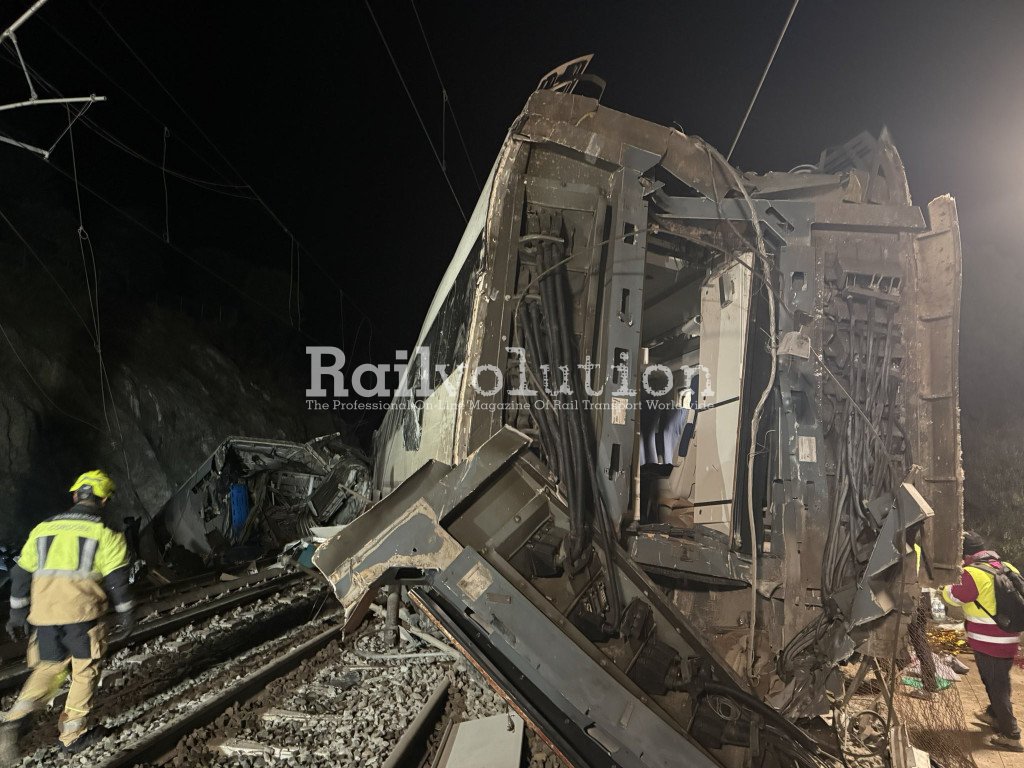
posted on 19th Jan 2026 00:15
At 18.45 on Sunday 18 January 2026 Iryo service 6189, formed of 109.012, departed from Málaga, its destination Madrid-Atocha, where arrival was scheduled for 21.34. On board were 289 passengers, the driver and four train staff. The 109 had been built in 2022, and had last been subjected to depot maintenance on 15 January 2026.
At 18.05 Renfe’s Alvia service 2384, formed of a four-car CAF-built Class 120 EMU, departed from Madrid-Atocha bound for Huelva with 184 passengers on board, scheduled to arrive at 22.02.
Neither train reached its final destination.
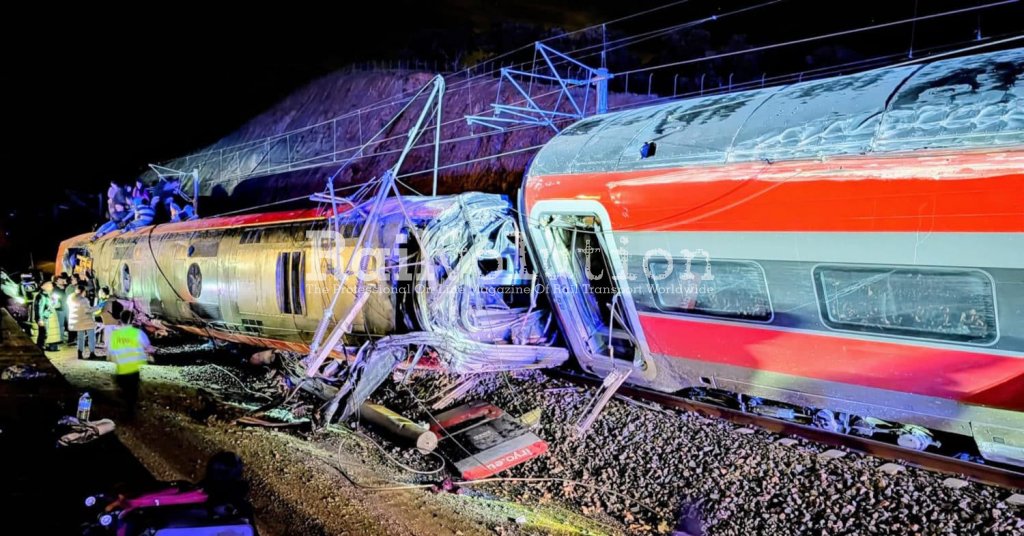
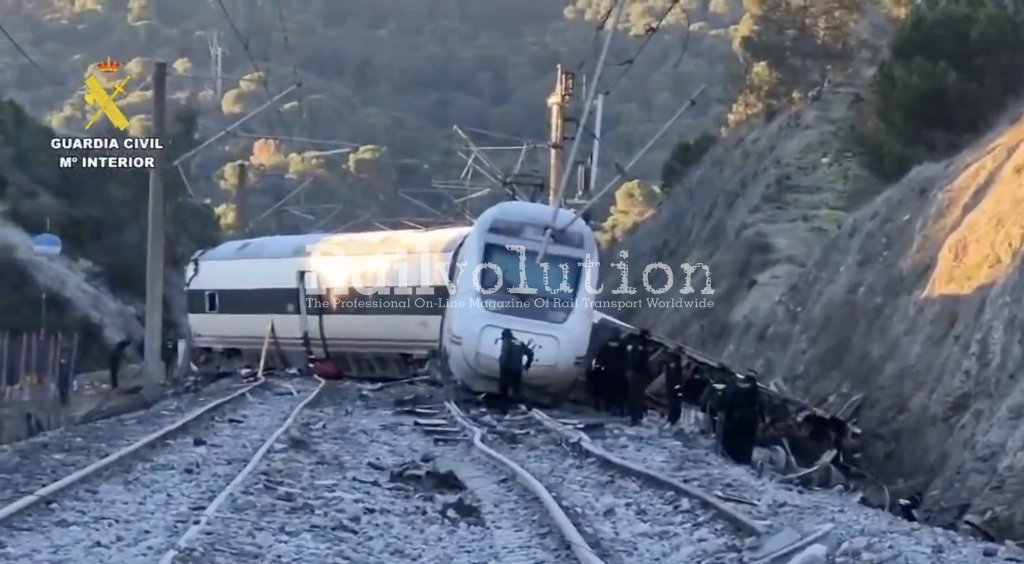
At 19.43 the last three cars of the eight-car 109, travelling at between 205 and 210 km/h partially derailed on a straight stretch of track, with a line speed limit of 250 km/h near the town of Adamuz, on the ascent from Córdoba through the Sierra Morena. This stretch of track had been renovated, the work completed in May 2024, as part of the comprehensive rejuvenation of the Madrid to Sevilla high speed line, which involved investment of over 700 million EUR.
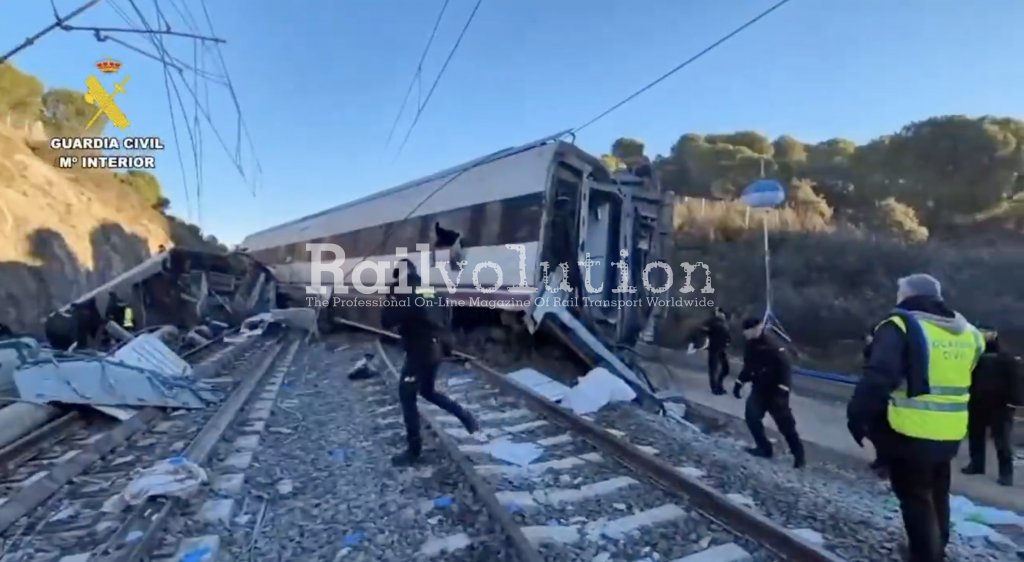
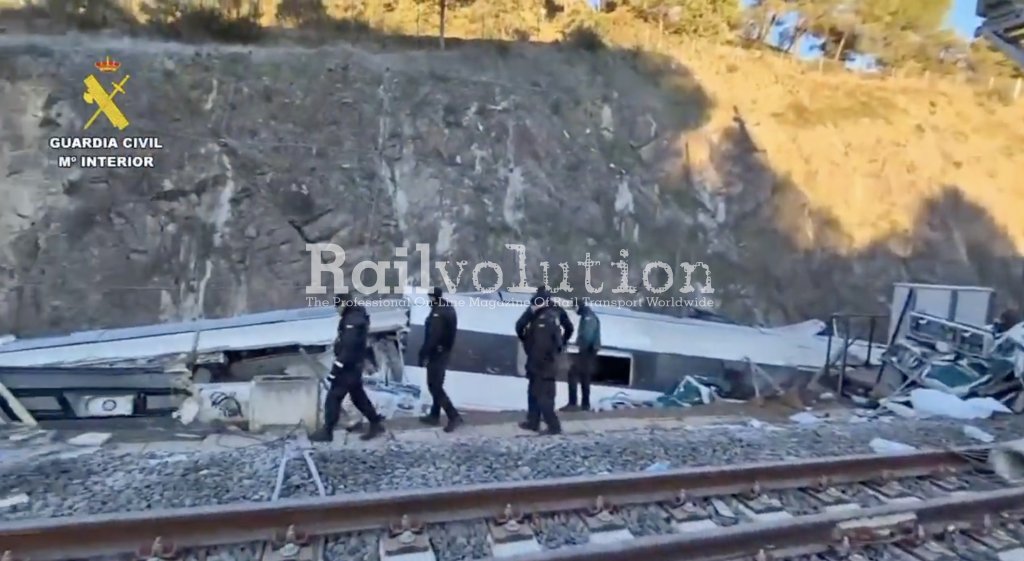
The two rear derailed cars of the 109 invaded the southbound track. Barely 10 seconds later the southbound Class 120, also travelling at between 205 and 210 km/h, ploughed into the end car of the 109, turning it over on its side. The momentum of the 120 was sufficient to carry it forward for several hundred metres before its two leading cars rolled over into a 4 m deep, narrow drainage culvert. The line here is in a cutting, but with wide, deep drainage culverts between the tracks and the sides of the cutting.
According to some passengers in the two rear cars of the 120, which remained upright, the driver applied the emergency brake on seeing the obstruction, but was unable to halt the train before the impact. Seat reservation statistics indicate that 53 passengers were travelling in the two leading cars of the 120. Aerial photos show that the two trains ended up around 800 m apart.
Access to the scene of the accident for rescue services was complicated, and over half an hour elapsed before the first fire service and ambulance teams arrived. Some of the first rescuers to reach the trains were inhabitants of Adamuz, who were able to take some of the passengers to the town’s social centre in their cars. This centre became the reception base for evacuated passengers, those who did not requir hospital attention later being taken by bus to Madrid, Córdoba, Sevilla and Huelva.
By noon on the following day, the number of fatalities had risen to 39, with many passengers in the first two cars of the 120 still unaccounted for. Around 100 passengers were injured, 43 requiring hospital treatment, and four in intensive care units (the numbers varied throughout the day up to 15). Among the dead was the driver of the 120. But the number of fatalities is expected to rise, once the crushed remains of the leading car of the 120 are removed from the drainage ciulvert. By evening on the 19th the number of fatalities had risen to 40.
The high speed line from Madrid to Córdoba, Málaga and Sevilla was, of course, put completely out of action, and will be so for at least four days, while the wreckage of the Class 120 is removed. This will be a difficult task, even using cranes, on account of the limited space in which to work. All Renfe, Iryo and OUIGO services to and from Andalucía using the high speed line have been suspended, probably until 2 February.
To alleviate the problem Renfe put on an extra train pair from Madrid via Cáceres and Los Rosales to Sevilla, while domestic airlines increased the number of flights. The conventional main line between Madrid and Sevilla is currently closed on account of clearance enhancement work in tunnels in readiness for ‘Rail Motorway’ services.
During the morning of the 19th Adif investigators discovered several sections of broken rail roughly 180 m from where the wreckage of the Class 120 was situated, but reckoned that it was too early to say whether these had anything to do with the derailment of the Class 109. Investigation into the case of the derailment is now in the hands of CIAF (Comisión de Investigación de Accidentes Ferroviarios) an independent accident investigation body, which reports to MITMS. CIAF has asked Adif or a complete record of usage of the section of line between Córdoba and Puertollano over the two days prior to the deailment.
One possible clue occurred during June 2025, when two incidents were reported regarding excessive vibration on board trains in the vicinity of Adamuz and Villanueva de Córdoba. These were attributed to new plates incorporated in the expansion joints of the rails, during the upgrading of the line. These were affected by high temperatures. The vibrations were detected by the LZB, which reported that the sections of track were ‘occupied’ by trains. The issue was rectified.
There were also problems in the area with track circuits, also rectified. It is unlikely that extreme temperatures could have been a factor in the derailment; however. During the evening of the 18th the air temperature in the southern Sierra Morena was around 6 ºC, falling to 2 ºC overnight.
