

El Topo: Spain’s first undersea railway
posted on 25th Nov 2026 21:42
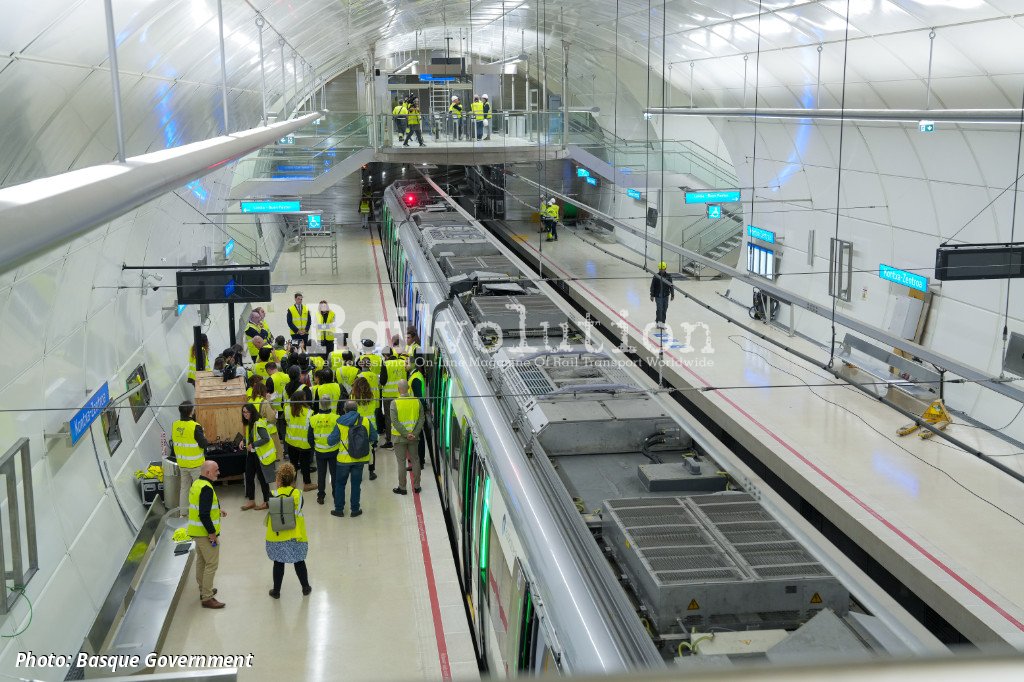
On 21 November 2026, Euskotren inaugurated the 4.2 km stretch of new railway passing underneath Donostia city centre, thereby eliminating the cul-de-sac terminus of Amara. There are now through hourly services between Matiko on Metro de Bilbao Line 3, Donostia and Pasaia, taking exactly three hours (service E1).
In addition there are train on service T1 from Lasarte-Oria to Irun and Hendaye (23 intermediate stations) with headways of 15 minutes as far as Irun, and Hendaye served every 30 minutes. Combined with service T0, from Añorga to Pasaia (11 intermediate stations), headways over the new stretch of liner, throughout the day, are just 7.5 minutes - in practice, seven or eight minutes between each train.
Construction of the new stretch of railway began in 2017, but was delayed by two years through geological problems, the pandemic, and increases in costs of raw materials and labour. The initial estimated cost, prior to tendering, was 181.5 million EUR. This November it was announced that the final cost was 292 million EUR, a 60% increase.
Test running began on 11 September 2026. These initial tests focused on clearances, including those at station platforms, and were problem-free, both on curves and on straight sections of track. The EMU used was loaded with varying weights to simulate the transport of passengers. Driver route learning then began, involving 197 drivers, who also had to familiarise themselves with the batch of five four-car Class 980 EMUs (similar to the rest of the Class 900/9040/950 family delivered from CAF since 2011).
The new line has three underground stations, at Bentaberri, Kontxa-Zentroa, and Amara. The latter is under the now-disused terminus, which was built during the late 1980s, and will now be redeveloped, along with the adjacent trackyard to thew south, for new housing.
Kontxa-Zentroa station is 40 m below street level, and hence well below sea level. On the promenade bordering the Playa de La Concha in Donostia, currently ranked as the 15th best urban beach in the world, there are two columns topped by what appear to be clocks. One is in fact a barometer. The promenade and the columns are the work of the architect Juan Rafarel Alday, and date from 1910.
Here ‘El Topo’ runs out, under the beach for around 200 m, to a maximum distance of 30 m from the promenade, thus becoming Spain’s first undersea railway, but only when the tide is high. It is anticipated that three three new stations on the cross-city line will be used by over seven million passengers annually.
One major change involved signalling and station signage. Contrary to the rest of the Euskotren network (and to the rest of the metre gauge and 1,668 mm gauge networks in northern Spain), for some reason right-hand running has been the standard practice on ‘El Topo’. But with the elimination of reversals at Amara, and with through running to and from Lasarte-Oria, it was necessary to switch to left-hand running! The first switch, between Hendaye and Galtzaraborda took place in February 2026. The final switch, between Pasaia and Anoeta, took place on the night of 20/21 November 2026.
