

Poland plans high-speed rail network for up to 350 km/h
posted on 25th Nov 2026 11:26
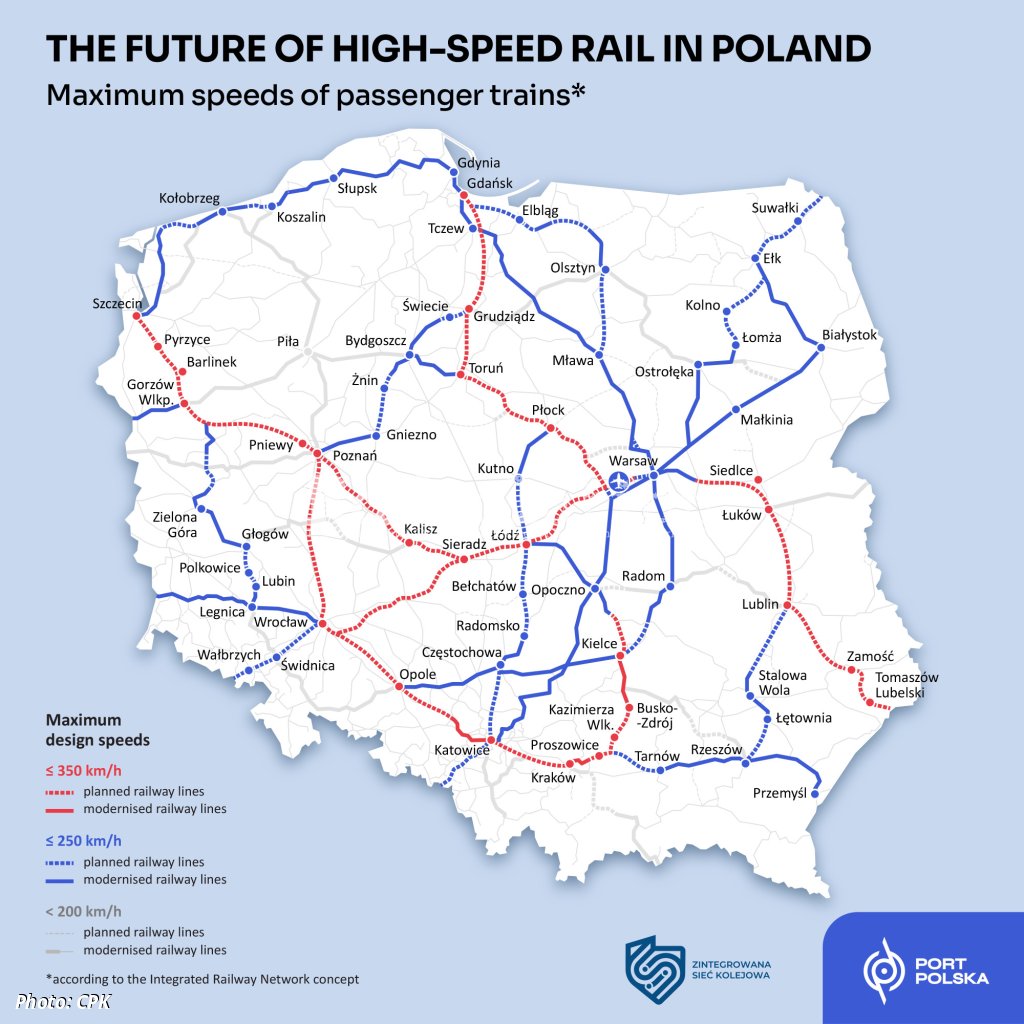
Poland is moving ahead with plans to develop a nationwide high-speed rail network, with new lines designed to accommodate trains travelling at speeds of up to 350 km/h. The first section is already under development as part of the Port Polska programme, with further routes planned to connect the country's largest cities and regions.
The first high-speed route, known as the Y Line, will connect Warsaw with Łódź, Poznań and Wrocław. The Warsaw – Łódź section is scheduled to open in 2032, with the connections to Poznań and Wrocław planned for completion by 2035. The wider network is intended to improve connections across Poland while strengthening the country's links with neighbouring European markets.
A new era for Polish rail
Poland's railway network is entering a new phase of development. Trains currently operate at speeds of up to 200 km/h between Warsaw and Gdańsk. From 2027, services on the existing southern section of the Central Railway Main Line (CMK) are expected to reach 250 km/h. The next step is to build infrastructure capable of supporting significantly higher speeds.
Under the Port Polska programme, new railway corridors are being planned between Poland's major urban centres. Their design speeds will reach up to 350 km/h, although actual operating speeds will depend on rolling stock, infrastructure, energy costs and operational considerations. Even in European countries with lines designed for 350 km/h, regular commercial services commonly operate at around 300 - 320 km/h, reflecting the balance between journey times and operating costs.
The infrastructure is being planned with a perspective of several decades in mind. This will allow the network to accommodate future technological advances, new generations of trains and developments in more affordable, low-carbon energy.
Where will the new high-speed lines run?
The Integrated Railway Network identifies a number of strategic corridors across Poland. The routes have been developed using forecasts from the Passenger Transport Model and Freight Transport Model, which assess future demand for passenger and freight services. The corridors shown on the current maps are indicative, with an accuracy of approximately 20 km. The precise alignments will be determined following further studies and analysis of alternative route options.
Lines designed for up to 350 km/h
The Y Line: Warsaw - Łódź - Poznań - Wrocław
The Y Line will be the first high-speed rail corridor developed under the programme. It will connect Warsaw with the new airport and Łódź, before branching towards Poznań and Wrocław via Sieradz and Kalisz. The Poznań branch is also planned to extend towards Szczecin via Gorzów Wielkopolski. A further connection towards Berlin is envisaged from Gorzów.
This would create a new high-speed route between Warsaw and the German capital, running via Gorzów rather than the existing route through Rzepin. The existing Railway Line 3 would continue to serve passenger traffic while accommodating more freight services.
Northern Central Railway Main Line: Warsaw – Gdańsk
Another major corridor will connect Warsaw and the new airport with northern Poland, running via Płock, the Toruń area and Grudziądz to Gdańsk. The line is being planned for speeds of up to 350 km/h, reflecting forecasts of particularly high passenger demand along this corridor.
Southern Main Line: Wrocław - Opole - Katowice - Kraków
The Southern Main Line will connect several of Poland's most important urban and industrial centres. It is also planned for speeds of up to 350 km/h. The same design speed is envisaged for the Poznań - Wrocław section.
Eastern Main Line: Warsaw - Lublin - Zamość - Lviv
In eastern Poland, the Eastern Main Line is planned to run from Warsaw via Siedlce and Lublin, continuing through Zamość towards Lviv in Ukraine. The planned corridor would strengthen east–west connectivity and create opportunities for improved international rail links.
A new route between Warsaw and Kraków
A further high-speed connection between Warsaw and Kraków is planned. Branching off from the Central Railway Main Line in the Opoczno area, the new route would run via Kielce and Busko-Zdrój to Kraków. Its design speed is also expected to exceed 300 km/h.
Lines designed for speeds of up to 250 km/h
The Integrated Railway Network also identifies a number of corridors where trains will be able to operate at speeds of up to 250 km/h. In eastern Poland, the Eastern Main Line will continue from Lublin via Stalowa Wola to Rzeszów. Other planned routes include: Kraków - Tarnów - Rzeszów - Przemyśl; Warsaw - Białystok - Ełk - Suwałki; Ostrołęka - Łomża - Ełk.
In western and central Poland, the planned Baltic–Czechia Main Line will connect the Tricity metropolitan area (Gdańsk, Gdynia and Sopot) with Bydgoszcz, Żnin, Poznań and Wrocław, before continuing via Wałbrzych towards the Czech Republic.
Other corridors include the North-South Main Line, connecting Płock with Kutno, Łódź, Radomsko, Częstochowa and Katowice, and a route from Wrocław via Legnica, Lubin and Głogów to Zielona Góra and Gorzów Wielkopolski.
In northern Poland, the network will include routes from Warsaw via Mława to the Tricity metropolitan area, from Gdańsk via Elbląg to Olsztyn, and along the Baltic coast via Słupsk and Koszalin to Szczecin.
The development of high-speed rail is expected to bring benefits beyond faster journeys. One example is the planned Eastern Main Line, which is expected to reduce the journey time between Rzeszów and Warsaw from approximately five hours to just two. Shorter journey times will improve access to employment, education and business opportunities, while making travel between Poland's regions more convenient.
The economic case for individual railway investments is assessed using passenger and freight transport forecasts. These models help identify where new infrastructure is likely to generate the greatest demand and deliver the strongest economic and social benefits. Time savings are particularly important. Faster connections mean less time spent travelling and more time available for work, business and leisure. Improved accessibility can also support regional development and strengthen economic links between major urban centres.
Planning Poland's railway network for the future
The Integrated Railway Network is a long-term initiative designed to identify the railway infrastructure investments Poland will need over the coming decades. The analytical work was commissioned by the Ministry of Infrastructure, acting on behalf of the Government Plenipotentiary for the Central Transport Hub. It was carried out by experts from Port Polska's Centre for Transport and Mobility (CTM), in close cooperation with PKP PLK and with support from the Institute of Urban and Regional Development (IRMiR).
The programme, announced in June 2026, establishes long-term priorities for the development of rail transport in Poland. Its recommendations take into account regional transport needs, economic considerations and national security requirements. The ultimate objective is to make rail an increasingly attractive and accessible option for everyday journeys, offering passengers a competitive alternative to road and air transport.
