

New FEVE trains - what is known so far
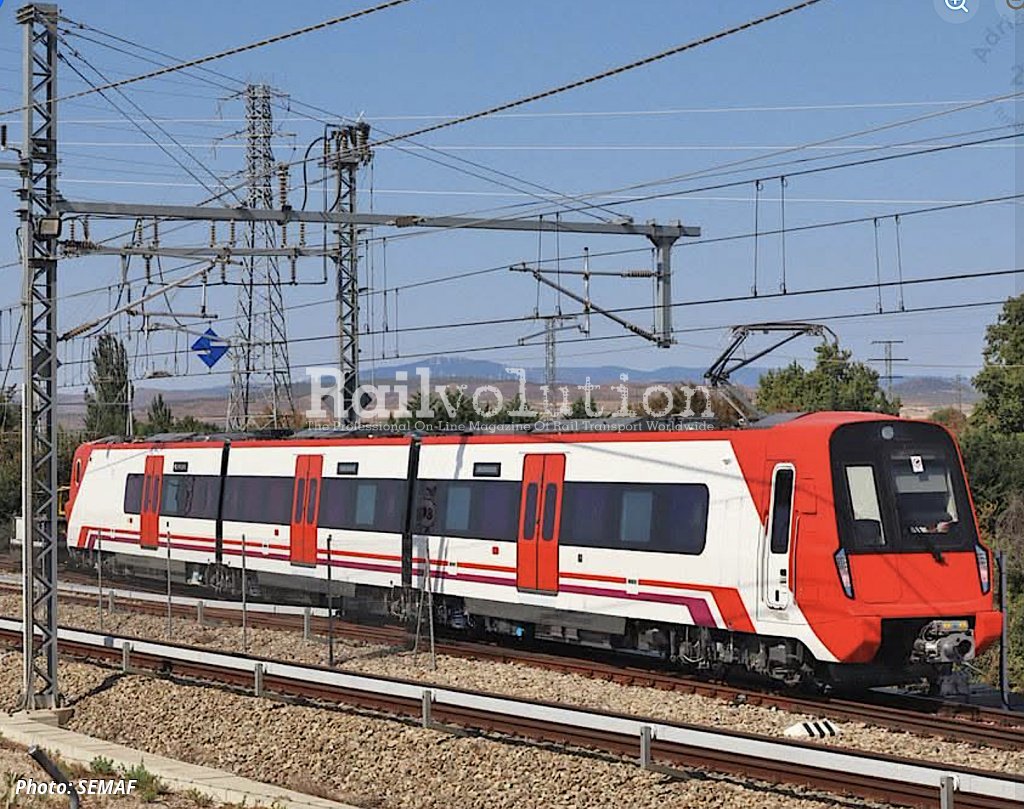
posted on 25th Aug 2026 17:03
As we all know, CAF is highly secretive regarding release of information, and Renfe’s requirements change with the direction of the wind. Construction of the new trains for the metre gauge (ex-FEVE) network in northwest Spain began at Beasain in February 2024, some of the work being later outsourced to Zaragoza and Irún. The first three-car EMU (Class 413) was completed by 31 July this year.
Even the number of trains, and their eventual allocation changes according to Renfe’s whims. By mid-August 2026, this was the intended situation (which may change...). In all 38 trains, not 37, are involved:
- 16 two-car Class 412 EMUs (47 seats, up to 149 passengers) for the Asturian Cercanías network,
- 16 three-car Class 413 EMUs (83 seats, up to 221 passengers) for the Cantabrian Cercanías network,
- 6 four-car Class 714 EDMUs (83 seats) for Media Distancia services. These are to be allocated to Santander depot, which means that they are intended for services from Santander to Bilbao and Oviedo. One of the cars wIll be a ‘technical vehicle’, housing the diesel engine and fuel tank.
The media in Asturias and Cantabria are getting confused over the whereabouts of the Class 413 on test on CAF’s 4 km line between Castejón de Ebro and Corella (Navarra). This train has not yet been moved to Cantabria for final verification and driver familiarisation. It will be moved there in the autumn, possibly in October. At Corella there are tracks of 1,445 mm and 1,000 mm gauges, with electrification at 1,500 and 750 V DC. At CAF’s Zaragoza factory there is a 300 m internal line for initial dynamic testing. At Corella running characteristics (including vibrations, noise, stability and acceleration and braking performance) of new trains can be assessed.
Afterwards, it will be possible to move the trains to the north coast network, for simulated commercial operation and for driver training. Five drivers from Asturias and four from Cantabria will be involved in this. The results obtained from this testing phase will then be incorporated in the construction of the remainder of the batches. From this it can be assumed that one Class 412 and one Class 714 are nearing completion and will debut at Corella soon. It is speculated that commercial operation of the new trains could begin during 2027, seven years or more after they were first ordered.
The six Class 402 EMUs for the Cercedilla to Los Cotos line (Cercanías de Madrid C-9) have been completed at CAF’s Beasain works, and are currently in store there, but can only complete testing and authorisation once rebuilding of this line has been finished, given its extreme gradient and curvature characteristics - at present work is heavily delayed. Authorisation was granted on 27 May 2026 and will lapse after a period of 24 months. There is no other railway in Spain with similar infrastructure characteristics that can be used for testing and verification purposes. Members of the train drivers’ union SEMAF are currently undertaking a series of familiarisation visits to Beasain prior to the start of test running.
Three-car DMUs and EMUs operated in Asturias until the 1990s, the entre cars then being removed. In Cantabria, notably between Santander and Astillero and Santander and Torrelavega ridership is greater, although much reduced from the levels attained a couple of decades ago. The same has happened in Asturias. The reasons? Ageing populations, and rural depopulation, as well as greater dependence on bus and private car transport, prompted by the ever-increasing unreliability of train services.
Notable features of the Class 413s (and, presumably, of the 412s and 714s too) are the use of articulation between the end and intermediate cars (a ‘first’ on the metre gauge network) and the single pair of entrance doors, situated roughly halfway along each car. This is a reflection of CAF’s design for its Media Distancia and high speed DMUs and EMUs, starting with the Class 120s. It enables the floor in the entrance vestibules to be slightly lower than in the seating areas, thus facilitating boarding and alighting. The same design feature, though with two pairs of entrance doors, is incorporated in the Class 46x Civia fleet. The CAF-built Class 2700 and 2900 DMUs, also used on some Cercanías services in Asturias and Galicia, also have just one pair of entrance doors per car.
It is anticipated that the 38 new trains will enable withdrawal of 44 ageing trains:
- 8 two-car Class 2400 DMUs (only five of which are currently operational), dating from the early 1980s, originally three-car formations. 61 seats.
- 12 two-car Class 3300 EMUs (former Class 3500, fitted around 15 years ago with asynchronous traction motors), based in Asturias, dating from the late 1970s/early 1980s, originally three-car formations. 72 seats, up to 255 passengers.
- 8 two-car Class 3500 EMUs (refurbished in the early 2000s, now in extremely run-down condition), based in Asturias, dating from the late 1970s/early 1980s, originally three-car formations. 72 seats, up to 255 passengers.
- 16 three-car Class 3800 EMUs, built by CAF in 1992, originally used in Asturias. 134 seats, up to 338 passengers.
Could some of these be ‘cascaded’ back to Asturias?
As regards the other metre gauge fleet members, the seven remaining Class 2600 DMUs (rebuilt Class 2300s) are approaching 60 years of age and are the most reliable DMU members in the metre gauge fleet. They are all currently based at León and Cistierna, and will remain in service while the ongoing debate over the future of tram-train operations into the centre of León continues.
Reliability of the most recent DMUs, the Class 2700s and 2900s, is fatal. Several Class 2700s have been withdrawn from service and will probably not be reinstated - in spite of the fact that these trains are still under 20 years of age.
In the seven years since the trains were fist ordered, battery technology, capacity and operating range has evolved substantially. The whole of the metre gauge network could, conceivably, be operated using BEMUs, with rapid charging facilities at Ribadeo, Collanzo, Llanes or Unquera, and Mataporquera and Cistiena.
