

TINA bogies modifications to reduce vibrations
posted on 4th Feb 2026 10:55
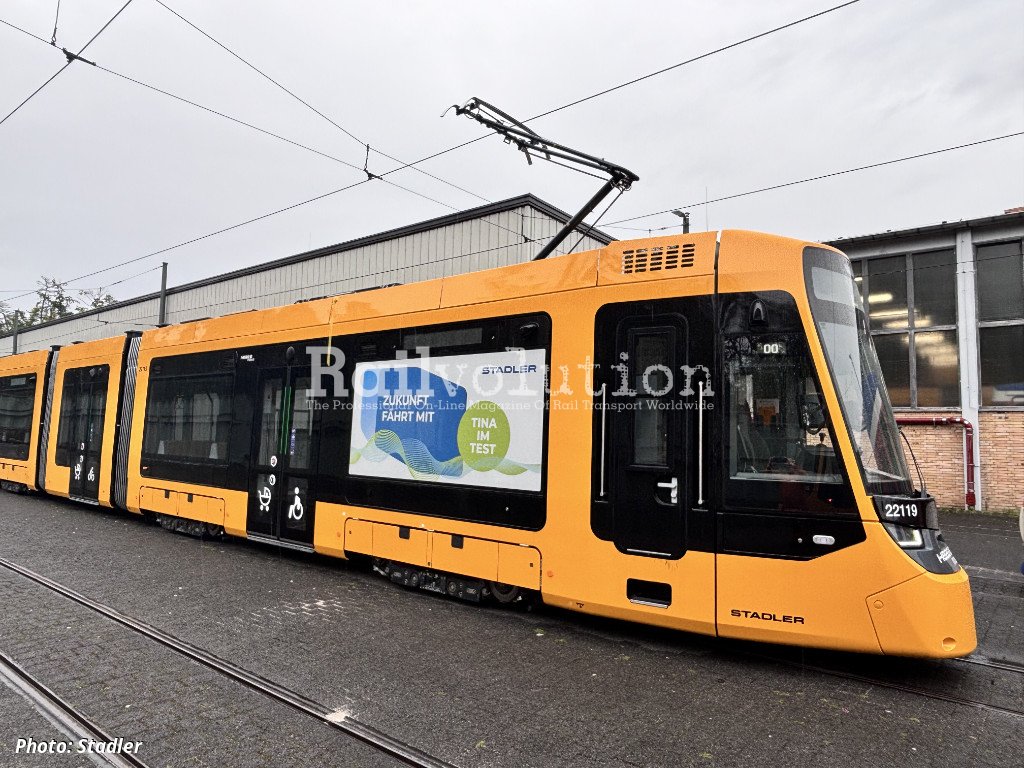
After problems with vibrations of TINA trams in Darmstadt (and Basel), Stadler is evaluating technical modifications to the bogies and preparing batch modifications. Stadler reports on the progress made in reducing vibrations along Darmstadt's tram lines. Following technical modifications to the bogies of the TINA trams, the evaluated results of the test runs conducted in December are now available. They demonstrate that the measures taken, through wheel optimization, have a measurable effect in Darmstadt and – depending on the structural conditions – contribute to a significant reduction in vibrations. The tests were carried out by an independent and accredited testing institute in accordance with the relevant standards and subsequently evaluated in detail.
Test runs in December 2025 - and why the results took time
The test runs took place in December on three representative sections of the Darmstadt tram network. Stadler selected the measurement locations based on technical criteria. Measurements had already been taken at all locations in a previous report by HEAG mobilo. At one measurement location on Wilhelm-Leuschner-Straße, the TINA vehicles recorded particularly high vibration levels compared to the older vehicles. Test runs were conducted with a modified TINA vehicle as well as TINA reference vehicles to record the effects of the modifications under comparable conditions.
The data was collected in buildings along the route according to the DIN 4150 standard. The evaluation of the extensive raw data, the calculation of the corresponding parameters, their technical plausibility check, and the subsequent assessment typically take several weeks, enabling Stadler to make reliable and verifiable statements. This approach builds upon the previously communicated methodology of conducting trials on the actual network with independent monitoring.
Results: Measurably fewer vibrations
The evaluated data show overall reduced vibrations with the modified TINA tram. The reductions were particularly noticeable on Wilhelm-Leuschner-Straße, where the greatest discrepancies between TINA and existing vehicles had been observed in the previous measurement. The maximum assessed vibration intensity was reduced by up to 51 % at one measurement point, with an average reduction of over 33 %.
At the other measurement locations, the measured vibration intensities were lower than on Wilhelm-Leuschner-Straße, resulting in smaller improvements. On Elisabeth-Selbert-Straße, a slight reduction in vibration intensity was observed at all measurement points; on Heidelberger Landstraße, the average improvement was also slight.
The measurements demonstrate that the wheel optimization is also effective in Darmstadt and that the assessed vibration intensities caused by vibrations in the modified TINA are lower inside buildings than in comparison tests with unmodified TINA vehicles. Differences between individual measurement series can be explained - as is typical for field measurements - by factors such as varying speeds and vehicle-specific variations. These effects were taken into account in the assessment and validated with existing measurement data.
Stadler plans further technical measures
Since there is evidence of the effectiveness of the technical modification to the wheels even at higher speeds, Stadler will further optimize the modifications and prepare them for batch modifications. In addition, Stadler has developed an extra technical measure in recent months and validated it through initial measurements in Basel. This measure promises further damping of vibrations, especially at low speeds. Stadler is currently planning the conversion of the Darmstadt TINA test vehicle.
If the planned modification also receives approval from the technical supervisory authority, the measure will be implemented in Darmstadt as well.
