Adamuz derailment - summary of events

posted on 22nd Jan 2026 13:04
Below is a summary of events of Adamuz derailment, as known on 21 January 2026:
18.10: Alvia (Class 120, four cars) departs from Madrid-Atocha, reporting number 2384, 187 passengers on board, destination Huelva.
18.40: Iryo (Class 109, eight cars) departs from Málaga, reporting number 6189, 289 passengers on board, plus driver and train crew.
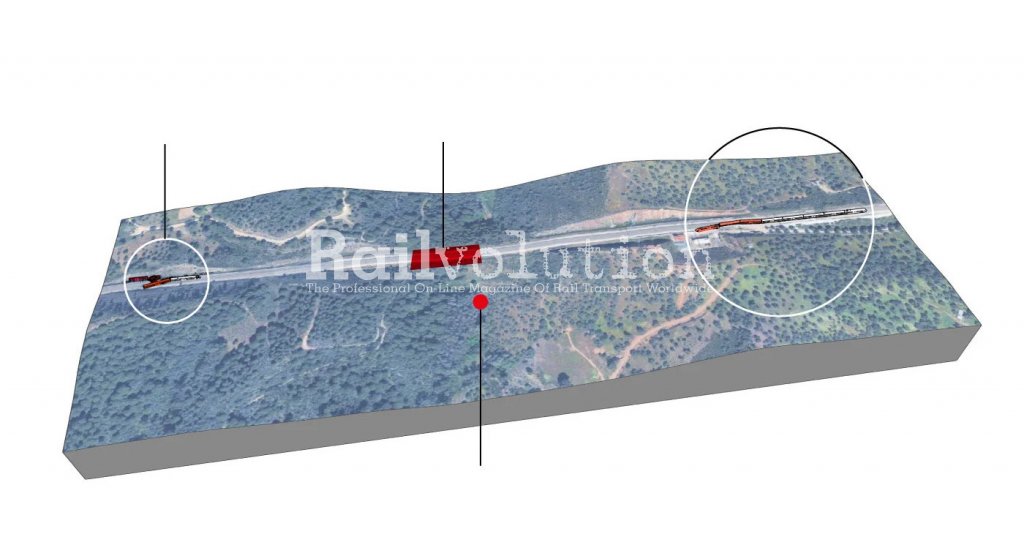
19.43.40: The last three cars of the 109 derail.
19.43.49: The southbound Class 120 collides with the derailed cars. Bodyshell impacts show that the Alvia struck the ends of cars 6 and 7, which must have been invading the southbound track. In other only nine seconds elapsed between the derailment and the collision.
19.45.02: The Iryo driver calls the Atocha control centre, stating that the train had become entangled with the overhead wire, and had come to a halt. The local CRC/CTC noted that the catenary had lost current at 19.43.45. The train was plunged into darkness (presumably the batteries failed to operate).
19.46.07: The CRC received a call from the driver of train 2181, which was following behind the Iryo service, stating that it had lost power, and had stopped.
On two occasions, at 19.48.39 and 19.48.51 the CRC attempted to contact the driver of the Class 120 EMU, without success.
19.49.53: The CRC established contact with the Alvia’s train manager, she said that she was suffering from head injuries, and would try to contact the driver. She was unable to do so, and kept repeating herself
19.49.35: The Iryo driver asked the CRC to halt all traffic on the line, aware now of the derailment of his own train, but unaware of the fact that the Class 120 had collided with it.
19.50: The CRC activated all emergency services via 112.
20.15: The driver of train 2181 informed the CRC that he, together with two other people, would inspect the line ahead. The CRC started to form national-level crisis committees.
On 19 January inspections of the bogies and wheelsets of the Iryo unit and the two remaining cars of the Alvia began. It was suspected that there had been a rail break, or a deformation of the rails. The main focus was car 6 of the Iryo, the first to derail. The event recorder was found, and the conversations in the cab noted and diffused to the media, which annoyed the unions, considering it to be a breach of privacy. Clearly, the driver only realised later that there had been a derailment.
On the 21 January more clues were found. By then the undamaged front cars of the 109 had been uncoupled and moved away from the scene of the derailment. The wheels showed signs of being slightly scarred or scratched (to a depth of just 1 mm, and a length of several cm, by some object – a broken or fractured rail, perhaps, which gave way at the moment car 6 passed over it. Laboratory investigation will now be necessary.
The other discovery was the leading bogie, possibly from car 8 of the Iryo unit, this yet to be determined in a stream 300 m from the site of the derailment. The bogie weighs about ten tonnes. The bogie was partially submerged in the Tamujosillo stream, which the railway crosses at that point, which is halfway between where the two trains came to rest. Òscar Puente later confirmed that it came from car 8. It was also later revealed that a second Renfe driver died on board the Class 120 EMU. He was travelling as a passenger with his family.
On the 21 January Adif announced further speed restrictions to 160 km/h on the high speed network, this time between Madrid and València, following observations of rough riding at two locations. These TRS only affect 1.8 km of the route.
A general strike of drivers in sympathy over the deaths of three of their colleagues, considered to be caused by poorly maintained infrastructure, has been called for 9 to 11 February.