

JR Central has introduced the new Class S0 Shinkansen concept
posted on 29th Oct 2026 09:37
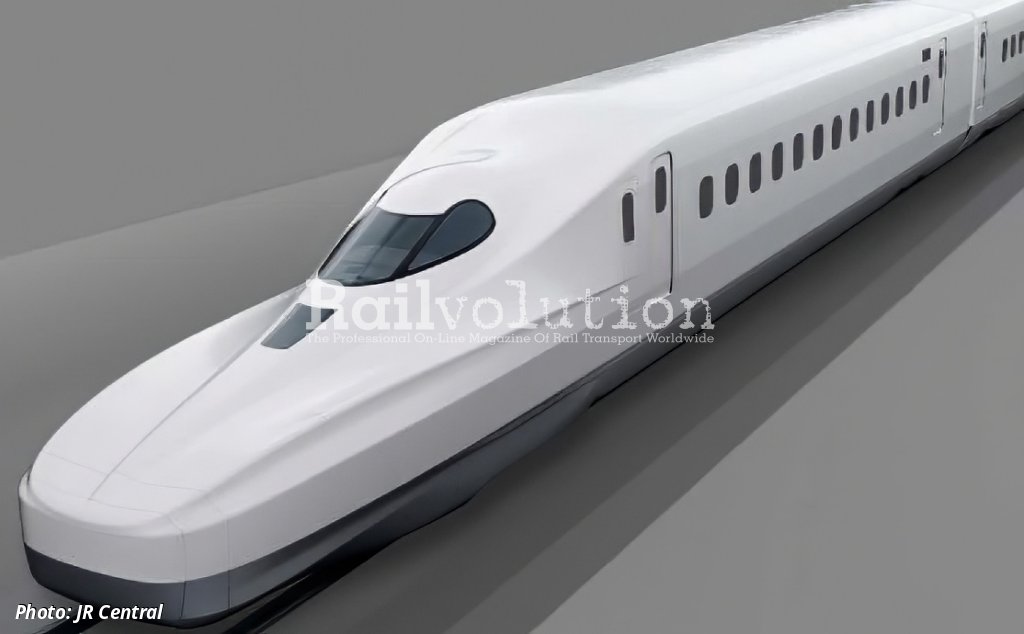
On 16 October 2026, JR Central introduced a new generation of high-speed Shinkansen trains for the Tokaido and Sanyo lines. The Class S0 designation has two meanings: zero symbolises a new starting point for the world's oldest high-speed line (resembling the original Class 0 trains), while "S" stands for “Shinkansen” and “Supreme”, the latter also being the meaning of the "S" in the previous Class N700S Shinkansen.
As with the N700S, the new train is designed as a standardised platform, allowing different length formations to be easily configured (for adoption by JR companies other than JR Central, which only operates 16-car Shinkansens).
GoA2 ATO and new radio system
The Class S0 Shinkansen will introduce a number of technical enhancements. They will be equipped with ATO at GoA2 level, which means that the train will run automatically and a fully experienced driver will be needed in the cab to give train the permission to move, deal with emergencies and perform additional driver-related tasks. This system has been under development for a few years and has been tested on the recent fleet.
The ATO will utilise a new millimetre-wave radio communication (40 GHz band) to transfer operational data between the track and the train. The system will calculate the optimal speed curve to arrive at the next station on time while minimising energy consumption. If there are unexpected speed restrictions (for example, due to severe weather conditions in some parts of the line), the system will automatically update the target speed profile using the latest information received via millimetre-wave train radio.
In other words, the train will adjust its speed in unrestricted parts of the line to compensate for lost time and minimise delays. TASC (Train Automatic Stop-position Control) ensures accurate stopping at the designated position. TASC has been used on all commercial trains since September 2026. JR Central developed the milimetre-wave system to replace the existing digital LCX train radio, whose transmission capacity was approximately 3 Mbps, while a millimetre-wave system is capable of up to 1 Gbps data transfers.
Enhanced earthquake safety
The aforementioned millimetre-wave train radio will also be used to transmit early earthquake warnings. This will reduce the current reaction time of 2 seconds (detected by shutting off the catenary voltage) to 0.2 seconds. New system will be an addition to the current one. Furthermore, the improved braking control will reduce braking distance by approximately 5 % during an earthquake compared to N700S EMUs.
The S0's aerodynamic nose will have a new shape, and together with more efficient (SiC) traction equipment, it will reduce energy consumption by approximately 6 % compared to N700S trains. Its shape is similar to a flight feather, which helps to control airflow. This design is intended to control airflow at both the leading and trailing ends of the train. Recycled aluminium will also be used in the bodyshell design more than on N700S to reduce environmental impact.
Improvements in passenger comfort
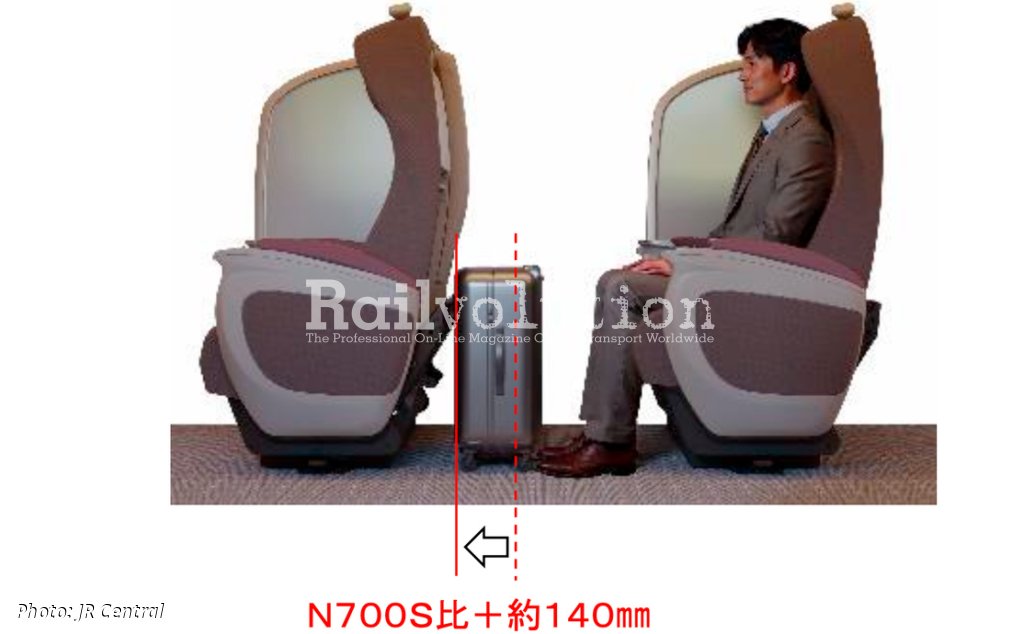
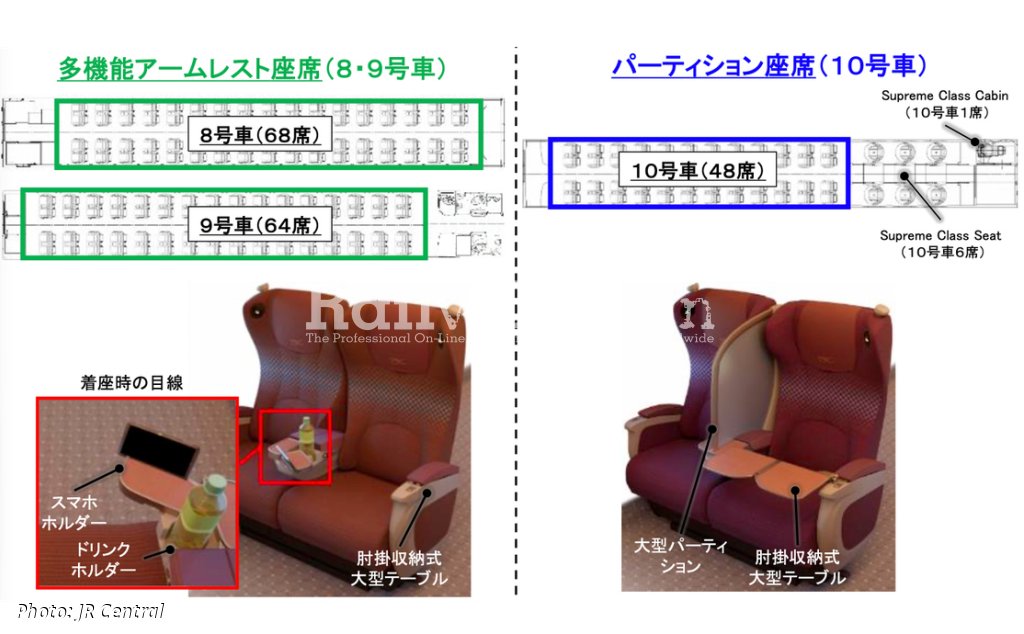
In cars 8 and 9, new seats with multifunctional armrests will be installed, including smartphone and drink holders, as well as a large table stowed in the armrest. Car 10 will have a section with six standard, separate compartments (each with one seat), as well as one separate Supreme Class Cabin seat. The remaining part of car 10 will have 48 standard seats. The generous legroom in Green Class will increase by approximately 140 mm compared to the N700S.
In car 9, there will be a grooming area. This will provide a comfortable space. It will allow passengers to attend to their appearance while travelling. The Wi-Fi and 5G reception will be improved. The active suspension control system will use a new algorithm to improve the quality of the ride. The plan is to reduce lateral body movement by approximately 10 % when trains pass by. This will apply to the Green Cars (8 - 10) and to ordinary Car 7.
JR Central is also addressing the issue of large baggage, which is largelly connected with the growing number of tourists travelling on the “golden route” (Tokyo – Kyoto). The number of luggage storage areas in the vestibules will increase from six to nine. These additional storage areas will be provided in cars 3, 7 and 15. The luggage racks above the seats will also be enlarged. This will be by roughly 25 % in end cars and by 5 % in intermediate cars, achieved by increasing both height and depth.
The final design of the exterior livery, including the blue stripes, is still to be decided. Commercial operations are scheduled to begin in July 2029 with eight S0 trains. An additional seven trains are planned for service in 2030, seven more in 2031, and three in 2032. Some of mentioned improvements will also be adopted in the still-produced N700S and retrofitted to the N700A Shinkansens.
