

Liebherr at InnoTrans: ‘Hands on the future’
posted on 21st Sep 2026 14:40
At InnoTrans 2026, Liebherr is showcasing innovative solutions in the field of rail transport and demonstrating how challenges can be overcome in the future by means of long-lasting and robust solutions. Strong, lasting partnerships are an important factor in Liebherr’s success, especially in a rapidly changing world of challenging economical conditions. Not only does Liebherr actively rise to the challenges of the future, it also serves customers and partners as a dependable partner, by their side when they need them. This is perfectly captured by the ‘Hands on the future’ slogan, which Liebherr has chosen for its presence at InnoTrans 2026.
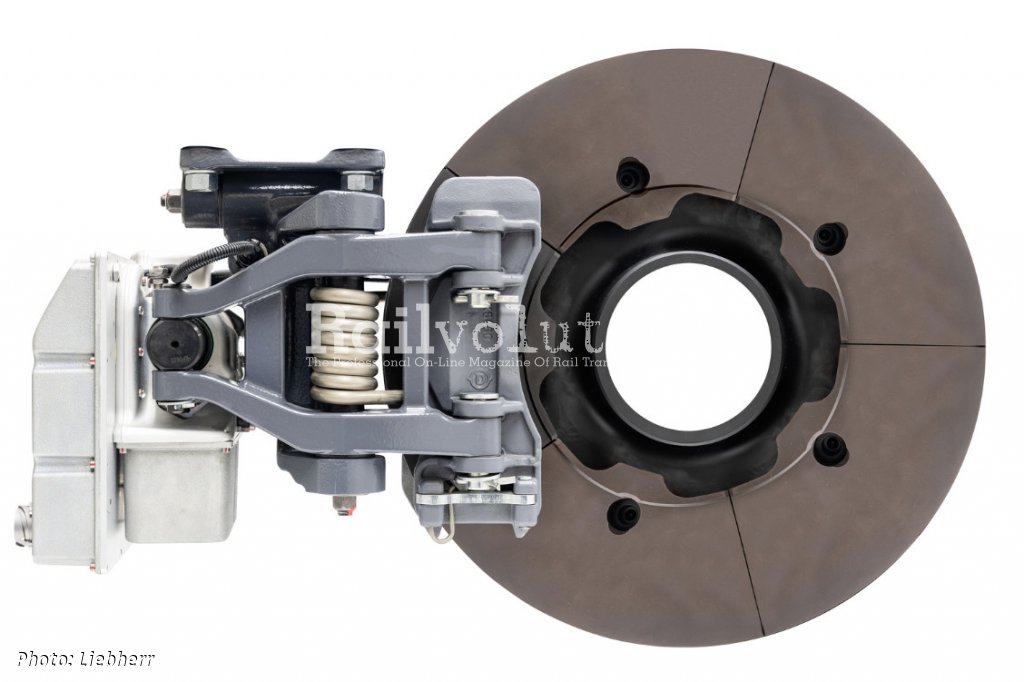
From an exhibition space spanning almost 392 m², the technology company is presenting heating, ventilation and air-conditioning systems (HVAC), which are designed for use with all conventional and alternative refrigerants and are set up for operation in a wide range of climate regions. Furthermore, Liebherr will be displaying smart actuators for rail vehicles. Among these exhibits is an axle-mounted brake disc actuator that has been in use in the X-Wagen trains of passenger services in and around Wien since 2023, alongside the latest version of an actuator for wheel-mounted brake discs, which has been further developed for use in Copenhagen’s city rail network.
To meet the growing demand for air conditioning technology and brake technology as well as local services, Liebherr is also presenting its ongoing and new investments for the range of products and services surrounding the rail system. Further to this, Liebherr is presenting two Generation 8 railroad excavators, one of which constitutes a world first.
HVAC systems with natural refrigerants for flexible use
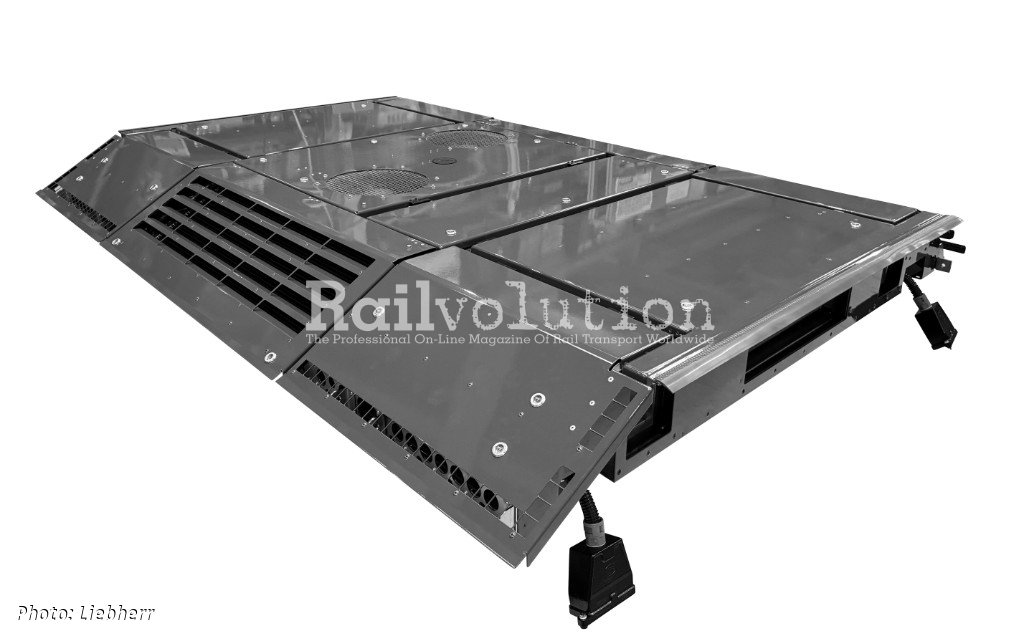
The air-conditioning systems from Liebherr-Transportation Systems excel in terms of performance and durability. The innovative HVAC systems can be operated with natural refrigerants such as propane, CO2 or ambient air, which has a global warming potential (GWP) of less than 1. At a GWP of 1, CO2 (R744) not only has a far lower global warming potential than conventional refrigerants but is also very energy-efficient.
The natural refrigerant propane (R290) facilitates a longer lasting cooling effect and, in terms of working pressure it is very similar to the previously used refrigerant R134. The corresponding technical concept, which takes into account all relevant safety requirements – such as flammability of the refrigerant – was developed by Liebherr and reviewed by independent experts.
The highly durable design of Liebherr’s HVAC systems makes them suitable for use in challenging application scenarios and climatic zones and even for reliable performance in extreme conditions. Whether used in desert regions or the subarctic, the air-conditioning systems are designed to operate in temperatures ranging from −40 °C to +65 °C and to withstand the challenging conditions that come with such extreme temperatures.
One example of Liebherr’s pioneering solutions is its propane system, developed especially for underground rail operations in Hamburg. What sets it apart is its high energy efficiency, achieved by means of optimised regulation of the cooling power of devices both in the driver’s cab and the passenger compartments. With its first deployment being in the stock of a prestigious underground rail network, the system represented a milestone in the use of natural refrigerants in urban rail transport.
MACS – modules for flexible cooling power
The modular MACS HVAC system impresses with its high degree of standardization, its low weight and its low overall height. The flexible design allows for several MACS modules to be installed in the vehicle to suit the power requirements and position, meaning one vehicle platform can serve multiple different application scenarios.
Intelligent brake actuators with no need for compressed air
Conventional braking systems used in rail transport are reliant on compressed air, which makes integrating them into the vehicle a complex process due to elaborate pipework and extensive maintenance of the rail vehicle, among other factors. The ‘Air-free Brake Actuator’, developed in partnership by Siemens and Liebherr, takes an altogether different approach.
By combining electrohydraulic actuation, integrated braking force control and SIL4-compliant safety architecture, the system performs the functions of the service brake, emergency brake and parking brake all in one single, compact unit. The result is a reliable and future-proof brake system that is ideally suited to use with digital, autonomous rail applications, that brakes quickly and efficiently and therefore facilitates capacity increases in the rail network without expanding the actual track.
Powerhouses in rail construction: the RE 22 M and RE 25 M railroad excavators from Liebherr
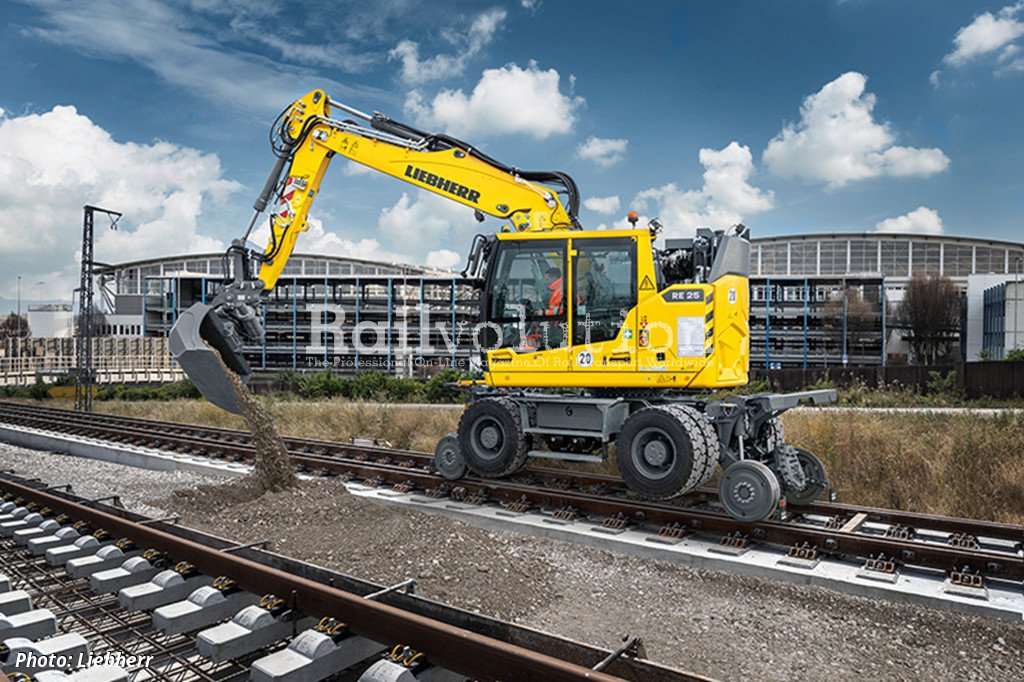
Liebherr is presenting a world exclusive at this year’s InnoTrans: the new RE 22 M. Together with the RE 25 M, also on display at the exhibition, it represents the eighth generation of railroad excavators to feature in the Liebherr portfolio. The RE 22 M is the successor to the A 922 Rail and the A 924 Rail, and, as a standard machine, it complements the RE 25 M, which is designed as a short-tail machine. With an engine output of 120 kW and a powerful hydraulics concept, both machines can be used for the independent operation of hydraulic attachments during work movements and travel movements.
Both machines feature the same undercarriage, an identical patent-pending rail guide system and a comfortable INTUSI double cab. The hydrostatic track wheel drive allows for driving in the raised position. Where permitted, the machines can also travel and work on the rails with the road wheels lowered. In this way, two different drive concepts are available in one machine, guaranteeing a high degree of operational flexibility. One optional central support also provides additional stability in the event of challenging work conditions.
The primary difference to the RE 25 M is the upper carriage. The design of the RE 22 M is based on its predecessor, the A 922 Rail. With a tail swing radius of 2,000 millimetres, the RE 22 M is designed as a standard machine. A heavy counterweight with a tail swing radius of 2,110 millimetres is also available as an option, provided this configuration is permitted in the market in question.
