

RegioPanter BEMUs to Latvia
updated on 12th Dec 2025 20:22 posted on 11th Dec 2025 11:33
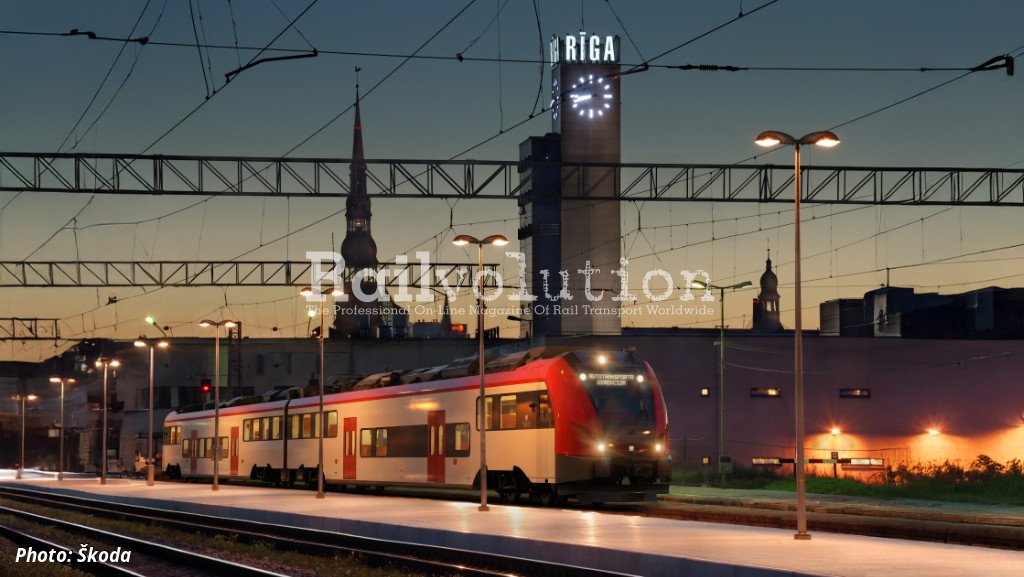
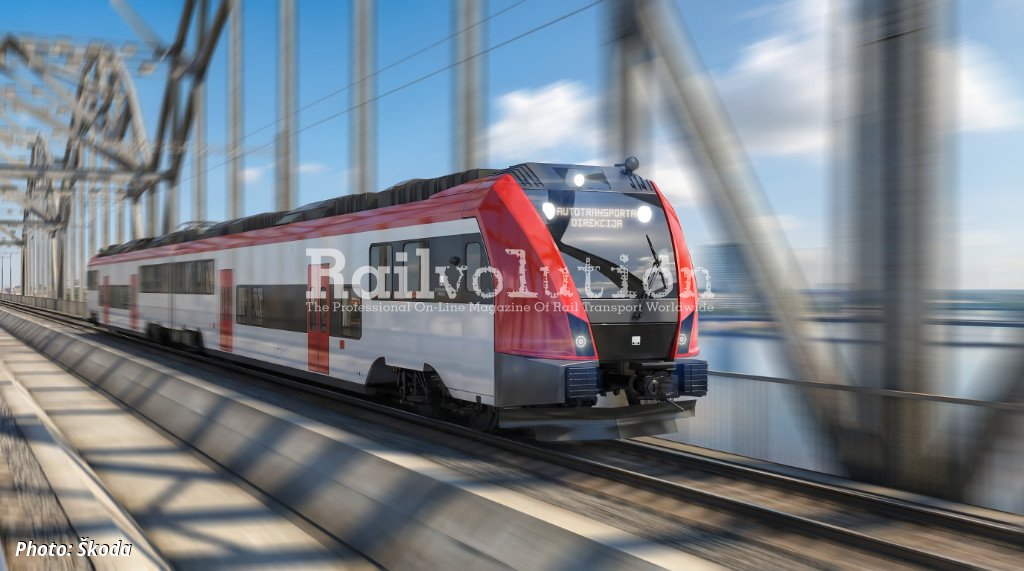
On 11 December 2025, Autotransporta direkcija and Škoda Group signed a contract for the supply of nine BEMUs worth 89,409,387 EUR. Financing is provided from the Latvian state budget and the EU Cohesion Fund. The contract includes the possibility of purchasing seven more trains if the necessary financing is found. If the option is confirmed, the value of the contract, including spare parts and personnel training, will increase to almost 160 million EUR.
Why ATD organised the BEMU procurement
The tender was organized by the Autotransporta direkcija (ATD, Road Transport Directorate), a state organization established in October 1993, then as the State Road Transport Inspectorate (Autotransporta valsts inspekcija). ATD is the implementer of a unified state policy in the field of passenger and freight transport.
There are two main ATD functions: issuing licenses for commercial transport of goods and passengers refers to road transport (trucks, taxis, international buses, etc.) is one of the main functions. But the other main ATD function is the organization of regional bus and rail public transport services in Latvia. It is this public transport authority function under which the BEMUs are being procured to make them available to the operators of the railway services.
Currently ATD has two PSO contracts: one with AS Pasažieru vilciens (Vivi) for the 1,520 mm railway network and one with SIA "Gulbenes - Alūksnes bānītis" for the Gulbene -Alūksne narrow gauge heritage railway services. In addition, ATD has an agreement with the Estonian Ministry of Climate to allow their cross-border Riga - Tartu PSO services.
ATD is an LLC that is fully owned by the Ministry of Transport. It carried out the BEMU procurement under a delegation agreement with the ministry. With this BEMU procurement ATD is aiming to make rolling stock available to PSO operators under neutral conditions. The current PSO contract with ViVi for Latvian railway services will end in 2032, with an option to extend it by up to two years. As such, ViVi will be the initial operator of the new BEMUs for the first few years. Afterwards both the existing 32 Škoda 16EV EMUs and the new BEMUs will be transferred to the next operator.
The new Škoda BEMUs will be owned by ATD. The existing Škoda 16EV EMUs are owned by ViVi, but they will be transferred to ATD if the PSO contract is not awarded to ViVi. Thus, ATD is the responsible authority for the state-owned vehicle pool.
The tender for the next Latvian PSO rail service contract is planned to be announced within the coming two years. ATD foresees that this tender will also include the requirement to procure the necessary rolling stock to replace the remaining old DMUs.
The BEMU contract
The ATD tender took place over three years, since April 2022, and involved CAF, Stadler Polska and the ŠKODA TRANSPORTATION - ŠKODA VAGONKA consortium, which attended the first round of the competition. In the second round, CAF did not submit a bid, thus only the ŠKODA TRANSPORTATION - ŠKODA VAGONKA consortium and Stadler Polska took part. However, for the latter ATD stated that the Stadler's documentation did not meet the tender requirements, thence Škoda was announced as the winner.
The supply for ATD follows on from 32 Class 16EV EMUs for ViVi (Pasažieru vilciens). For Škoda, this is the second order for BEMU abroad after the order from ZSSK, and the first version of the RegioPanter BEMU for the 1,520 mm track gauge.
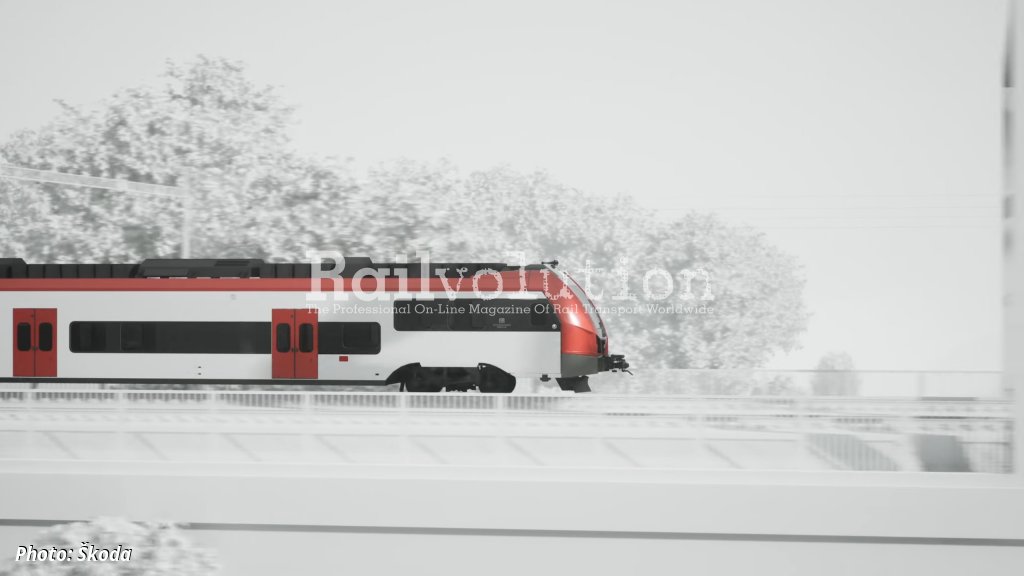
The Škoda BEMUs are planned to be deployed from the first half of 2029. They will be two-car units, capable of operating on 3 kV DC and 25 kV 50 Hz. Their maximum speed in catenary mode will be 160 km/h and in battery mode 120 km/h. They will have an axle arrangement Bo‘2 + 2‘Bo‘, a length over the couplings of 56,540 mm, a width of the bodyshells of 3,430 mm and a height of 4,560 mm above the TOR. The minimum radius of the curve negotiated will be 150 m.
The BEMUs are required to be capable of performing passenger services on the unelectrified Zemitāni - Sigulda - Zemitāni (89 km) section without charging. However, in practice a maximum distance between charging locations of around 80 km is foreseen. The traction power of the trains was not disclosed at present.
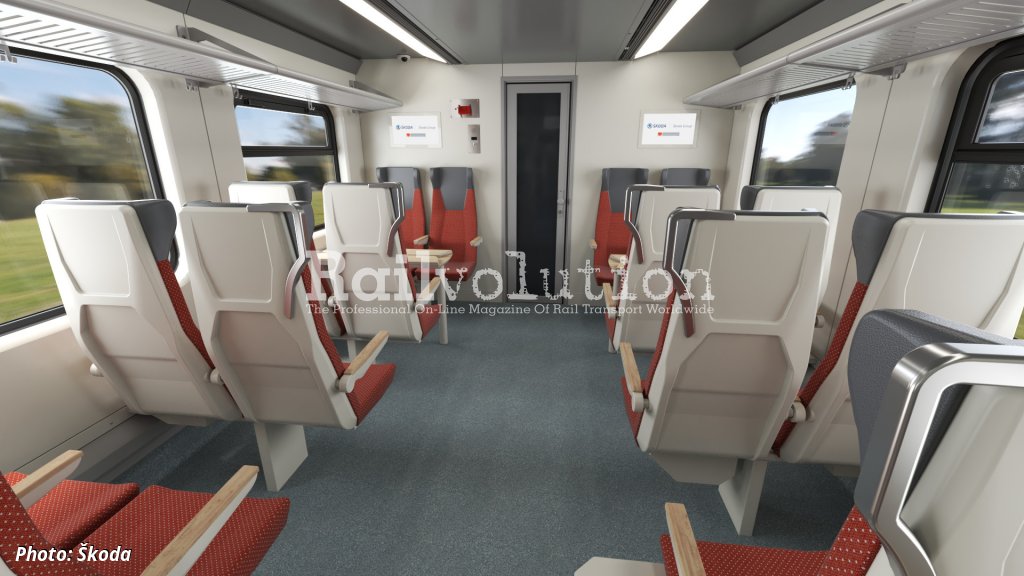
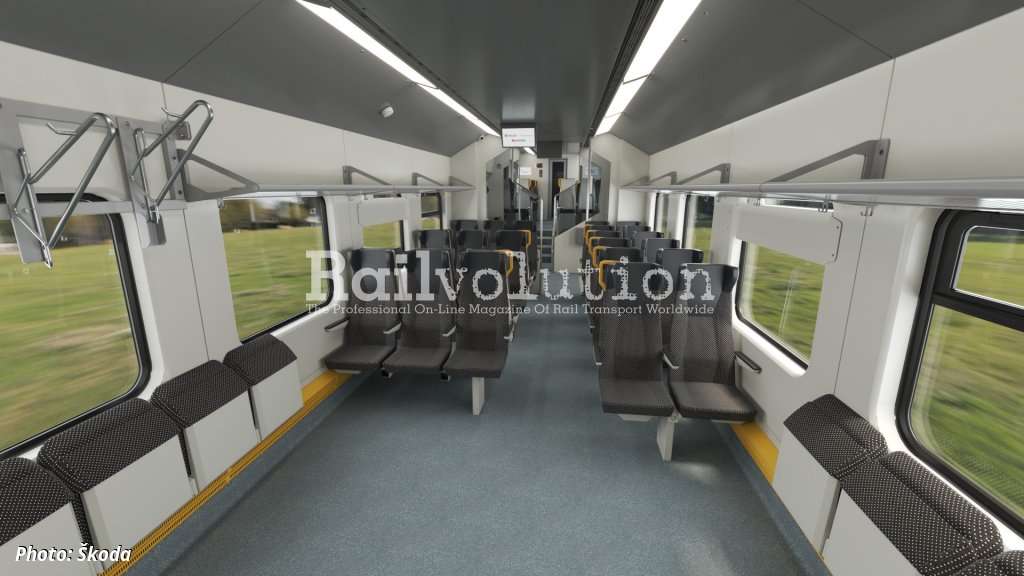
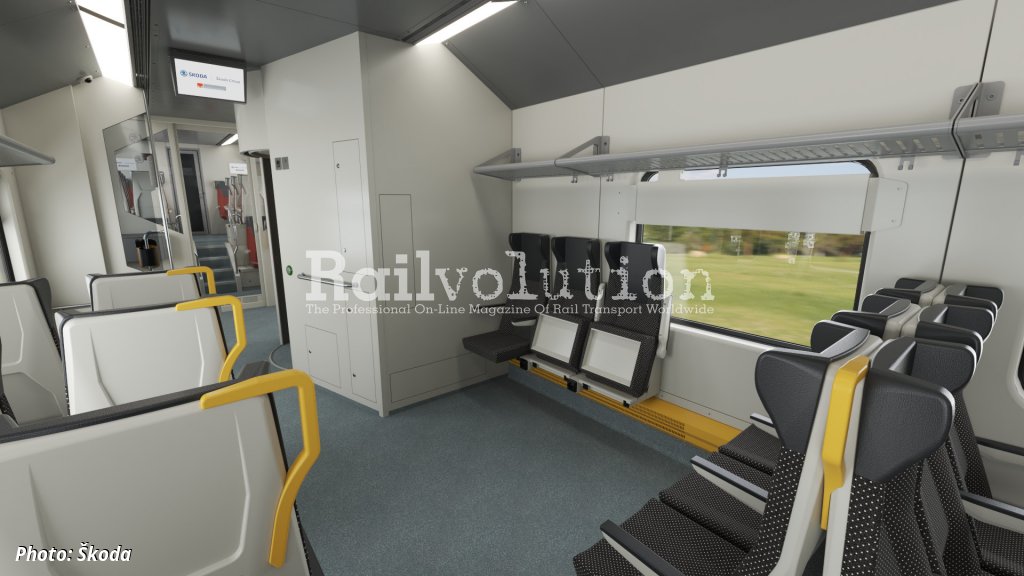
The low-floor part of the vehicle will be 600 mm above the TOR. Each train will offer 188 seats, of which 24 in the first class in a 2 + 2 configuration. In the second class, on the other hand, the seats are in a 3 + 2 configuration. Jānis Lapiņš, Chairman of the Board of Directors of ATD, adds: “Conditions for passengers with bicycles will also be improved. While old diesel trains usually have a high floor and only three places for bicycles, the new battery trains will have space for eight bicycles in the low-floor part, four of which in a vertical and four in a horizontal position.”
The BEMU operation
The BEMUs will run mainly on the Rīga - Daugavpils and Rīga - Cēsis lines, where the necessary charging infrastructure will be built for them. However, ATD does not exclude also the possibility of BEMU workings on the Rīga - Sigulda or Rīga - Krustpils services.
On Rīga - Cēsis (93 km) route currently only 4 km are electrified between Rīga and Zemitāni. Charging stations are planned in Sigulda (49 km from Zemitāni) and Cēsis (40 km from Sigulda). Due to the short electrified section in Riga, some train services may continue through Riga to Bolderāja to increase charging time - this shall be decided at a later date. Eventually it is planned to electrify the Zemitāni - Sigulda section.
On Rīga - Daugavpils (218 km) route currently 82 km are electrified between Rīga and Aizkraukle. Charging stations are planned in Krustpils (47 km from Aizkraukle), Līvāni (29 km from Krustpils) and Daugavpils (60 km from Līvāni). Eventually it is planned to electrify the Aizkraukle-Krustpils section.
The present operation
Currently, transport on non-electrified lines of the entire Latvian railway network is provided by 23 DMUs of Classes DR1A, DR1AM, and DR1AC, built between 1980 and 1992. In addition, one daily international service to Valga is operated with a LTG Link's DMU (built by PESA).
Nine BEMUs will therefore replace part of the existing diesel trains, and thanks to the higher starting acceleration and the use of the speed of 120 km/h on the relevant non-electrified sections, it will be possible to shorten the travel time up to 15 - 25 minutes. Seven optional BEMUs would allow replacing most of the diesel trains and also serving additional destinations, such as to Rēzekne and Valmiera.
The Rīga - Rēzekne service (223 km) is planned if the funding is approved for at least two BEMUs from the option. This service splits off the Rīga - Daugavpils line at Krustpils. Additional charging stations are then planned in Līvāni (69 km from Krustpils) and Rēzekne (26 km from Līvāni).
The Rīga - Valmiera route (120 km) would be a 27 km extension of the Rīga - Cēsis services. This would require an additional charging station and the purchase of the remaining BEMUs from the option. Funding for this has not yet been identified.
The Latvian rail network
Currently ATD organizes rail services on four electrified suburban lines around Riga (to Skulte, Aizkraukle, Jelgava, Tukums) and on five unelectrified lines (Valga direction, Gulbene direction, Zilupe direction, Indra direction and Liepāja direction), which includes unelectrified Rīga - Sigulda suburban services. In addition, LTG Link operates the unelectrified Vilnius - Riga commercial service. A large number of unelectrified rail lines in Latvia are freight-only and do not see any passenger services.
The infrastructure manager LDz is currently electrifying and constructing passenger platforms in Riga on the previously freight-only line to Bolderāja. Passenger services on this new line will likely start in the end of 2026.
Earlier it was also planned the conversion of electrified lines from 3 kV DC to 25 kV 50 Hz. According to the information available, LDz has chosen the following approach to this conversion. In the initial phases, the old catenary is being fully replaced and made AC-compatible, in some cases in combination with track geometry and safety-related upgrades for speed increase to 140 km/h. However, the substations would be rebuilt from DC to AC only after the catenary on the entire network is replaced - sometime in the 2030s. Only after this LDz would focus on electrifying new route sections.
Currently four out of five rail lines from Riga are affected by major ongoing catenary reconstruction works, which has reduced high-demand services to running only hourly. Major catenary works on the core network in and around Riga will continue until 2029, with some works moving into the 2030s. The seven planned BEMU charging stations are planned to be 25 kV AC and designed with future railway electrification extension in mind.
